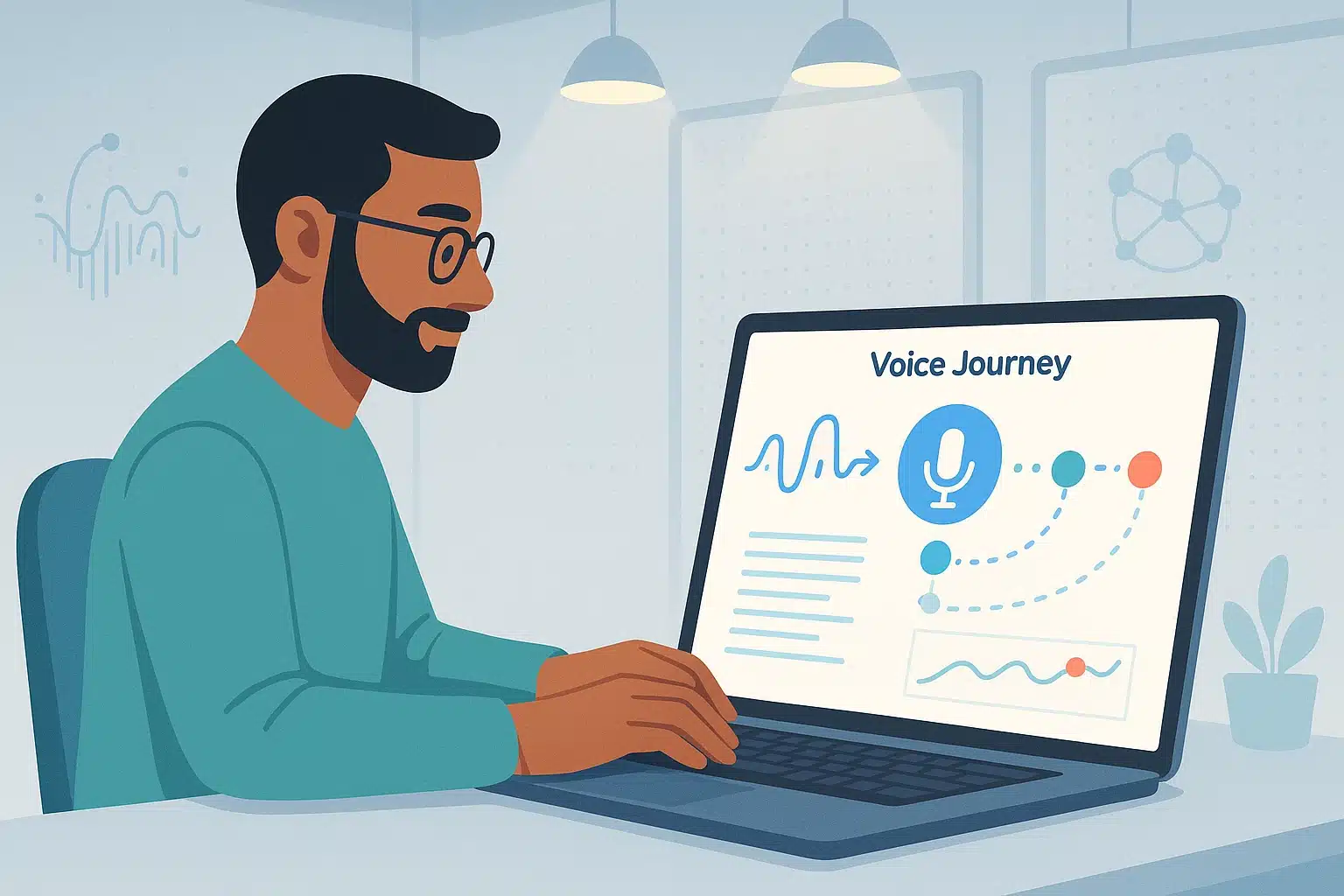
Voice Agents are vocal conversational agents, skilled in understanding, conversing, and taking action thanks to artificial intelligence. Discover why they are significantly more advanced than traditional voice assistants, along with the numerous promises tied to this technology!
Engaging with a machine has never been more natural. Voice commands for turning on lights, booking tickets, or receiving a health diagnosis were once the realm of science fiction, but are now becoming integral to daily life. Behind the soothing voice of your trusted assistant lies a profound transformation: the rise of voice agents.
These conversational agents, equipped with artificial intelligence, can interpret intentions, understand context, and even improvise. We’ve come a long way from the rigid scripts of the early Siri or Alexa. Current voice agents learn, engage in dialogue, adapt, and sometimes even astonish.
With an estimated 8.4 billion voice assistants globally by 2025 and market forecasts exceeding 47 billion dollars by 2034, one thing is clear: voice is a new interface. So how do these agents operate? In which fields do they excel? And most importantly, why are they transformative?
More than just a voice assistant
On the surface, a voice agent appears similar to a voice assistant. Yet, in reality, there’s a notable distinction. Traditional voice assistants, like Siri or Google Home, perform pre-programmed commands: “set a timer,” “play music,” “call mom.” In contrast, a voice agent serves as a vocal conversational agent, comprehending natural language, engaging in continuous dialogues, considering context, and often utilizing generative AI models.
The tech behind the voice
The voice you hear is merely the final layer of a complex technology pipeline. Beneath the surface, numerous technical components play a role.
It begins with Automatic Speech Recognition (ASR), which captures your voice, processes it, interprets it, and converts it into text. Subsequently, Natural Language Understanding (NLU) comes into play, where AI attempts to grasp your true intent beyond mere words.
A simple query like “Can you remind me to call my mom tonight?” can trigger various logics: calendar, contacts, time, tone. The decision engine subsequently determines the best response or action based on rules, databases, or generative models.
Lastly, Text-to-Speech (TTS), often driven by neural networks, transforms everything into a smooth, more human-like voice than ever before. And the process is incredibly rapid. Recent advancements in latency reduction, emotion detection, and adaptive natural voices have been remarkable.
Modern agents can detect frustration in one’s voice, modulate their tone, or redirect to a human if necessary. As an added bonus: LLMs like ChatGPT, Gemini, or Claude now empower these agents to generate rich, personalized, occasionally even creative responses.
Billions of voices worldwide: the numbers behind a global surge
If it feels like voice agents are ubiquitous… that’s because they indeed are. In 2024, there were 8.4 billion active voice assistants globally. That’s more than the number of people on Earth.
From smartphones and smart speakers to vehicles and everyday objects, voice has become a universal interaction method. The market is following the same ascending trajectory. The Voice Agents market alone is projected to reach 47.5 billion dollars by 2034.
On another front, Voice Commerce is anticipated to account for 89.8 billion dollars by the end of 2025, propelled by the convenience of voice ordering. For most voice AI-related projections, the CAGR surpasses 30%. Yet beyond the raw figures, it’s the tangible business benefits that stand out.
Expect up to a 30% reduction in call handling time in customer service. Customer satisfaction increases by 31.5%, resolution rates by 14%, and retention by 24.8%. Consequently, more businesses are expected to integrate GPT voice agents by the end of 2025. And this is merely the start. As these agents improve, they increasingly become central to practical use cases…
Health, finance, retail… industries embracing voice
The surge in voice agents isn’t just a passing trend; they address real business needs. Across several industries, they already save time, reduce costs, and at times even foster trust.
In hospitals, 44% of institutions have already adopted voice agents. They assist doctors with file management, remind patients of appointments, handle incoming calls, and partake in teleconsultation automation.
As a result, 65% of healthcare providers report reduced mental workload, and 72% of patients feel at ease speaking to an agent. In finance, including banks and insurance, voice agents efficiently manage around-the-clock customer support, secure simple inquiries (check balance, address update), and alleviate hotline congestion.
Deploying a Voice Agent for your projects
Some banks even utilize voice agents capable of verifying identities through voice biometrics, boasting reliability that surpasses that of fingerprints. Retail and e-commerce are prime areas for voice commerce. Ordering groceries, inquiring about products, tracking deliveries, or activating customer support-all can be accomplished via voice.
And it works. Already, 27% of Google searches on mobile are conducted vocally. Additionally, in connected cars, voice agents are evolving into intelligent copilots. Peugeot, Kia, and Lucid have embraced this innovation. In industry, they streamline tasks for technicians through hands-free voice commands. In the energy sector, they ease alert reporting and incident analysis.
Crafting a meaningful voice: UX challenges
It’s often overlooked: voice is an interface, not just a medium. And like any interface, it necessitates careful design. A quality voice agent shouldn’t merely “respond”. It must listen, comprehend, and most importantly, avoid frustration.
The pace, timbre, pauses, transitions between responses, the ability to rephrase… every element counts. Conversations are not with a form but with an entity. While a graphical interface allows for exploration, voice offers a single chance: should the agent err, interrupt, or seem soulless, users will abandon the interaction.
This is why increasing numbers of companies are investing in conversational design, meticulously selecting voices (human or synthetic), tones (serious, warm, professional…), and language intentions.
And beginning in 2023, with advancements in neural synthesis, it has become possible to create bespoke voices capable of expressing surprise, irony, and emotion. Voice is no longer merely an audio output but a comprehensive user experience. It has the power to make a service either unforgettable or unbearable.
Creating your own voice agent in 2025: tools to know
Great news: you don’t need to be a Google engineer to develop a voice agent. Platforms such as Voiceflow, Alan AI, Dialogflow, Amazon Lex, or SoundHound Studio have democratized the creation of voice agents.
They allow users, through a visual interface or APIs, to design a vocal conversational agent connected to business back-ends, CRMs, payment services, or even generative AI. With Voiceflow, for example, designers can create a complete voice journey without writing a single line of code, incorporating conditional logic, API connectors, response variations, and even emotional nuances.
Some tools go beyond, integrating LLMs (language models) or customized intent recognition systems from the outset, allowing agents to respond with nuance, context, and memory. This accessibility has noticeable outcomes: from startups to major corporations, voice agents are now swiftly developed.
They can be deployed for ephemeral uses, marketing events, or as internal assistants. We are witnessing a true “no-code voice generalization”.
Voice agents and generative AI: promise or illusion?
With the integration of LLMs such as GPT, Claude, Mistral, or Gemini, voice agents have fundamentally transformed. Gone are the prerecorded scripts. Enter free-form, contextual, adaptive conversation. An agent empowered by generative AI can comprehend complex requests, respond with nuance, improvise, reformulate, or even ask clarifying questions.
This capability allows, for example, Google Assistant, now integrated with Gemini, to handle a request like: “Can you remind me who came to dinner at my place two weeks ago, and book the same restaurant for me?”.
It merely needs to analyze calendars, messages, and geolocation data. However, this power comes with challenges. AI might fabricate information with confidence, a phenomenon known as hallucinations. Consequently, it can mislead users by discussing nonexistent topics.
The response time also extends, since crafting a coherent spoken sentence takes more time than a scripted one. It’s also challenging to control precisely what the agent will say, which can cause issues in customer support scenarios. The oversight is limited.
We mustn’t disregard the inference cost. Each query to an LLM demands a substantial (and costly) infrastructure. Even if generative agents are impressive, they need well-defined boundaries. This is why they’re often employed in a hybrid approach: scripts for straightforward requests, LLM for intricate or emotional ones. Nonetheless, we are just at the beginning. The technology will evolve, gradually addressing its shortcomings…
Privacy, security, and bias: the overlooked challenges of voice
The sensitive issue of confidentiality lingers. Voice agents facilitate more natural interactions. Yet, the smoother the voice, the more it might provoke anxiety. Because behind the conversational magic, several gray areas persist. Some systems retain voice data for model training. Where? For how long? By whom?
Each voice is unique, hence identifiable. Used for security and voice biometrics, it can also inadvertently become a key to access if mishandled. The capability to discern frustration or fear is valuable… but could also be intrusive if improperly managed.
Moreover, some accents are poorly interpreted, and certain intonations are processed less accurately depending on language or cultural contexts. Voice agents might therefore perpetuate societal biases.
And worse: voice deepfakes, capable of mimicking a voice from mere seconds of recording. Scams, impersonation, manipulation… the risks are genuine, and regulations are almost nonexistent. Mitigating these threats calls for ethical agent design, transparent opt-out or opt-in options, and procedures for redirecting to a human in case of doubts.
Conclusion: Voice Agents, giving a voice to conversational AI
They never rest, grasp your intentions, and respond with fluidity. Voice Agents are no longer merely a futuristic promise: they are now a reality, woven into our phones, vehicles, services, and routines.
Yet this new era of vocal technology also provokes concerns: about autonomy, trust, privacy… and the role we wish these agents to play in everyday interactions. Are you eager to understand how voice agents function and design one of your own?
Join the artificial intelligence training offered by Liora. Our AI Engineer program equips you to master machine learning fundamentals, natural language processing, and integrate models like GPT into practical projects. This includes voice agents.
Thanks to our practice-based instructional methods, you’ll learn to use AI generative tools, grasp conversational agent architectures, and create voice prototypes using Python, LangChain, or specialized APIs.
Our courses are offered in bootcamp, continuous, or apprenticeship formats, and are eligible for CPF or France Travail funding. Explore Liora and infuse voice into your AI projects.
You’re now up to speed on Voice Agents. For further insights on this subject, read our comprehensive article on Voiceflow and our article on NLP!