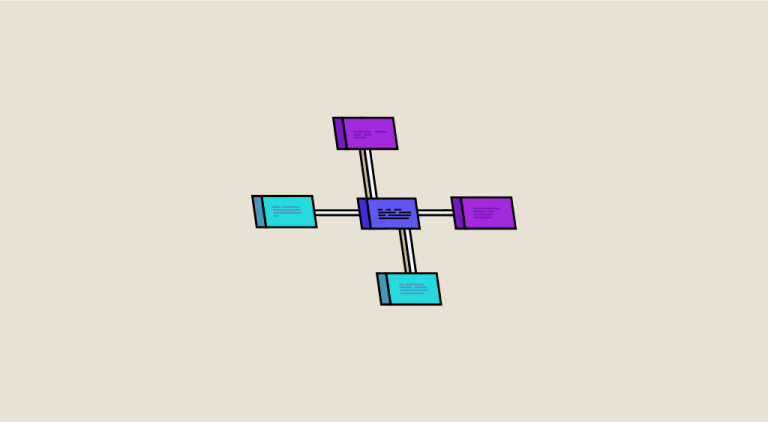
Microservices architecture is an innovative approach to software development that has gained in popularity in recent years. This solution involves dividing an application into several small, simple and independent services.
But why opt for such an architecture? In this article, find out what microservices are, their advantages and disadvantages, and how they can be implemented within an organization.
Understand how microservices work
Microservices are a software development architecture that consists of breaking down an application into several small parts, called services.
Each service is autonomous and interacts with the other services to provide overall application functionality. In other words, microservices are bricks that, when assembled, form an application.
Defining microservices
Microservices are therefore services that can provide functionality for an application while remaining autonomous and independent.
They are designed to be deployable and replaceable components, which can be combined and orchestrated to create a large-scale application.
Docker containers are a perfect example of microservices architecture. They allow you to concentrate on developing modules, without having to think about dependencies. Cloud applications are now developed using this architecture.
Advantages of microservices
Microservices architecture offers a number of advantages for businesses, including :
- Scalability: microservices can be deployed and scaled independently of each other.
- Flexibility: each service is developed independently, making it easy to update and modify.
- Reduced downtime: if one of the elements encounters a problem, this will have no impact on the application’s other services.
- Unlike monolithic architectures, the application continues to function while the fault is being resolved.
- Recycling of microservices: each module can be used in other applications.
In addition, microservices enable a better distribution of tasks between developers, who can work on specific services rather than on the whole application. This can improve code efficiency and quality.
Microservices can also facilitate the adoption of new technologies, as each service can be developed in a different programming language.
Disadvantages of microservices
However, microservice architecture also has its drawbacks. The complexity of communication between different services can be a challenge, as can the management of multiple services.
In addition, monitoring and debugging can be more complicated. Microservices may require a more complex infrastructure to manage communications between different services. Nevertheless, the advantages of this architecture quickly make up for these few points.
Example of a microservices application
Let’s take the example of an e-commerce site. A microservices application for an e-commerce site could include services for
- user management ;
- product management ;
- order management
- payment management.
Each service would be developed independently and could be scaled up or down according to demand. For example, if the order management service is in high demand during peak periods, it can be scaled up without affecting the other services.
Modules could be developed in a different programming language, depending on the skills of the developers and the technical requirements of the service. Finally, microservices allow greater flexibility for updates and modifications. If a service needs to be modified, it can be replaced without affecting the website’s other services.
The fundamentals of microservices
Microservices is a software development method that involves creating applications using small, independent services that communicate with each other via APIs. The advantages of this architecture stem from its fundamental principles.
Modularity and module independence
Microservices should be developed as self-contained, independent modules with their own business logic. This enables easy reuse of services in other applications, and facilitates maintenance. Each microservice must be designed to perform a specific task, and be capable of operating independently of other services.
To take the example of the e-commerce site, you can have microservices for product management, order management, user management and payment management. Each microservice can be developed and deployed independently, enabling greater scalability and flexibility.
How do microservices interact with each other?
Microservices interact with each other via an interface, usually an API. The team clearly defines the interactions and contracts between the different services to ensure efficient communication. APIs are designed so that microservices can communicate seamlessly, without depending on each other.
Communication between microservices can be synchronous or asynchronous. In synchronous communication, the calling service waits for a response from the called service. In asynchronous communication, the calling service sends a request to the called service and continues to operate without waiting for an immediate response.
Data management
In principle, microservices are designed to manage their own data. This facilitates the management and maintenance of each service. Data can be stored in a database specific to each service, or in a centralized storage service. Using a service-specific database reduces complexity and facilitates maintenance. A dedicated API is generally used to share data.
Security and authentication
Security is essential in a microservices architecture. Each service must be secured individually, with appropriate access controls and permissions. Authentication and authorization are also important to ensure that authorized users can access the appropriate services. These security mechanisms protect data and services from attack. Microservices are then designed to be resilient and capable of rapid recovery in the event of failure or attack.
Microservices architecture at a glance
In conclusion, microservices are a software development approach that enables scalability and flexibility. By following the fundamental principles of modularity, independence, communication, data management and security, you can create robust, scalable applications. Development teams can deploy applications faster and more efficiently, focusing on specific tasks rather than complex projects and monolithic applications. Microservices are an exciting approach to software development, offering many benefits for developers and users alike.