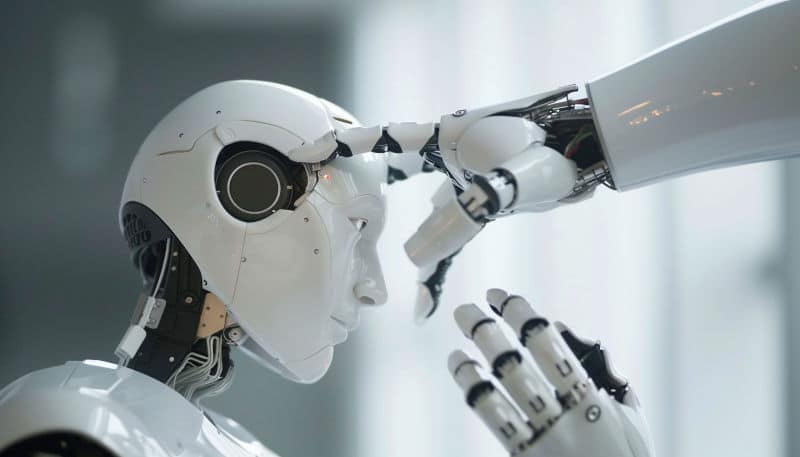
The boundary between artificial intelligence and human intelligence is becoming increasingly blurred. One of the key differences between the two is the ability to convey and comprehend emotions. On this note, humans had a head start. That was until EQ-Bench came along. So, what is it exactly? Let’s find out.
What is EQ-Bench?
Launched on December 11, 2023, EQ-Bench is a benchmark designed to assess aspects of emotional intelligence in large language models (LLMs). The idea is to help them better understand complex emotions and social interactions. By doing so, they can predict the intensity of emotional states during a dialogue.
Indeed, the models use a set of computational techniques to comprehend emotional intelligence (calculation, reasoning, object recognition, etc.). For instance, furrowed brows are generally a sign of annoyance. But not always; there can be subtleties. And these are much more pronounced in real life than in the databases LLMs are trained on.
The role of EQ-Bench is precisely to evaluate models’ capabilities to interpret these subtleties within a dialogue.
How does EQ-Bench work?
To enable LLMs to grasp emotional intelligence, EQ-Bench employs basic techniques from traditional psychometric tests, with some innovations. Thus, the model reads a dialogue and evaluates the emotional response. It must be able to predict the magnitude of 4 presented emotions. The result is then scored without the intervention of a judge (avoiding length bias).
Thanks to its operation mode, EQ-Bench has produced results that strongly correlate with human preferences and multi-domain benchmark tests (MMLU).
Why train LLMs in emotional intelligence?
Humans are governed by their emotions. Allowing large language models to deepen their understanding of complex emotions enables them to inch closer to human intelligence.

And this can be beneficial across all business sectors. Here are some examples:
- Marketing: algorithms can analyze customer comments on social networks more precisely. But above all, with EQ-Bench, they are able to anticipate responses. The chatbot can then tailor its dialogue according to the desired emotional outcome. This is particularly useful if it aims to encourage a purchase. emotionally intelligent AI
- Robotics: a companion robot equipped with emotional AI could better understand and respond to the emotional needs of its user. companion robot
- Education: virtual assistants dedicated to learning could more easily detect a student who is bored or doesn’t quite understand a concept. Consequently, the assistant can adjust the teaching approach to enhance learning.
From decision-making to interpersonal interactions, emotional intelligence is omnipresent. Robots that fully embrace it are thus able to better meet human expectations.
Towards an alignment of human intelligence and artificial intelligence
Before answering this question, it is essential to revisit the very concept of emotional intelligence. It is split into four branches:
- The perception of (non-verbal) emotions;
- The use of emotions;
- The understanding of emotions;
- The management of emotions.
However, EQ-Bench focuses on one aspect of emotional intelligence: the understanding of emotions. In other words, the ability to comprehend and interpret complex emotions and their implications in social contexts.
Today, it’s a real challenge for models since they are trained on static (and often exaggerated) expressions of emotion. From a perceived emotion, AI models will draw a predetermined conclusion. Yet, human emotions are fluid and nuanced. They can shift suddenly as scenarios unfold. The challenge for EQ-Bench is precisely to incorporate all the factors that can influence emotions and to understand all its nuances.
Even though EQ-Bench is a step forward in understanding emotional intelligence, there is still a long way to go before AI and human intelligence align perfectly.
In the meantime, improving large language models is always possible. And it starts with training in data science.