
Since their introduction in 2017, Transformer models have dramatically transformed the AI landscape, particularly in the field of natural language processing (NLP).
Created to address the limitations of recurrent neural networks (RNNs), Transformer models utilize self-attention mechanisms, enabling parallel data processing. Employed by renowned systems like ChatGPT, BERT, and ViT, they have paved the way for applications ranging from real-time translation to genomic analysis. This article delves into their operation, their impact, and the associated challenges.
What preceded Transformers?
Prior to 2017, the prevailing models for processing sequences (text, speech) were recurrent neural networks (RNNs) and their variants, such as LSTM (Long Short-Term Memory). These architectures handled data sequentially, maintaining a “memory state” updated with each step. However, they faced two significant issues:
- Gradient vanishing problem: In long sequences, information from the initial tokens (words) was lost.
- Prolonged training time: Sequential processing curtailed parallelization, slowing learning on large data sets.
To mitigate these issues, researchers introduced attention layers, allowing models to focus on pertinent segments of the input. For instance, in an English-French translation task, the model could directly access crucial words of the source sentence to produce an accurate output. Nevertheless, these mechanisms remained coupled with RNNs… until the Transformer revolution.
How were Transformers developed?
Discussed in the pivotal paper “Attention Is All You Need” (Vaswani et al., 2017), this architecture eschews RNNs in favor of pure attention, combined with novel techniques.
It comprises these essential components:
1. Positional Encoding
Unlike RNNs, Transformers do not process tokens sequentially. To maintain sequential information, each word receives a positional vector (sinusoidal or learned) denoting its position in the sentence.
2. Self-Attention
The essence of the Transformer lies in self-attention layers, where each token interacts with all others via three learned matrices:
- Query: Represents what the token seeks.
- Key: Determines what the token can provide.
Value: Encloses the information to be transmitted.
Attention weights are calculated by dot product between queries and keys, then normalized by a softmax function.
This mechanism allows each token to draw on the entire context of the sentence, independent of its position, thus fostering a better understanding of linguistic relationships.
3. Multi-Head Attention
To capture various relationships (syntactic, semantic), each layer employs multiple attention heads in parallel.
Each attention head learns a distinct representation, allowing the model to concurrently extract multiple levels of meaning, such as grammatical dependencies and semantic relations.
The results are concatenated and transformed through a feed-forward neural network.
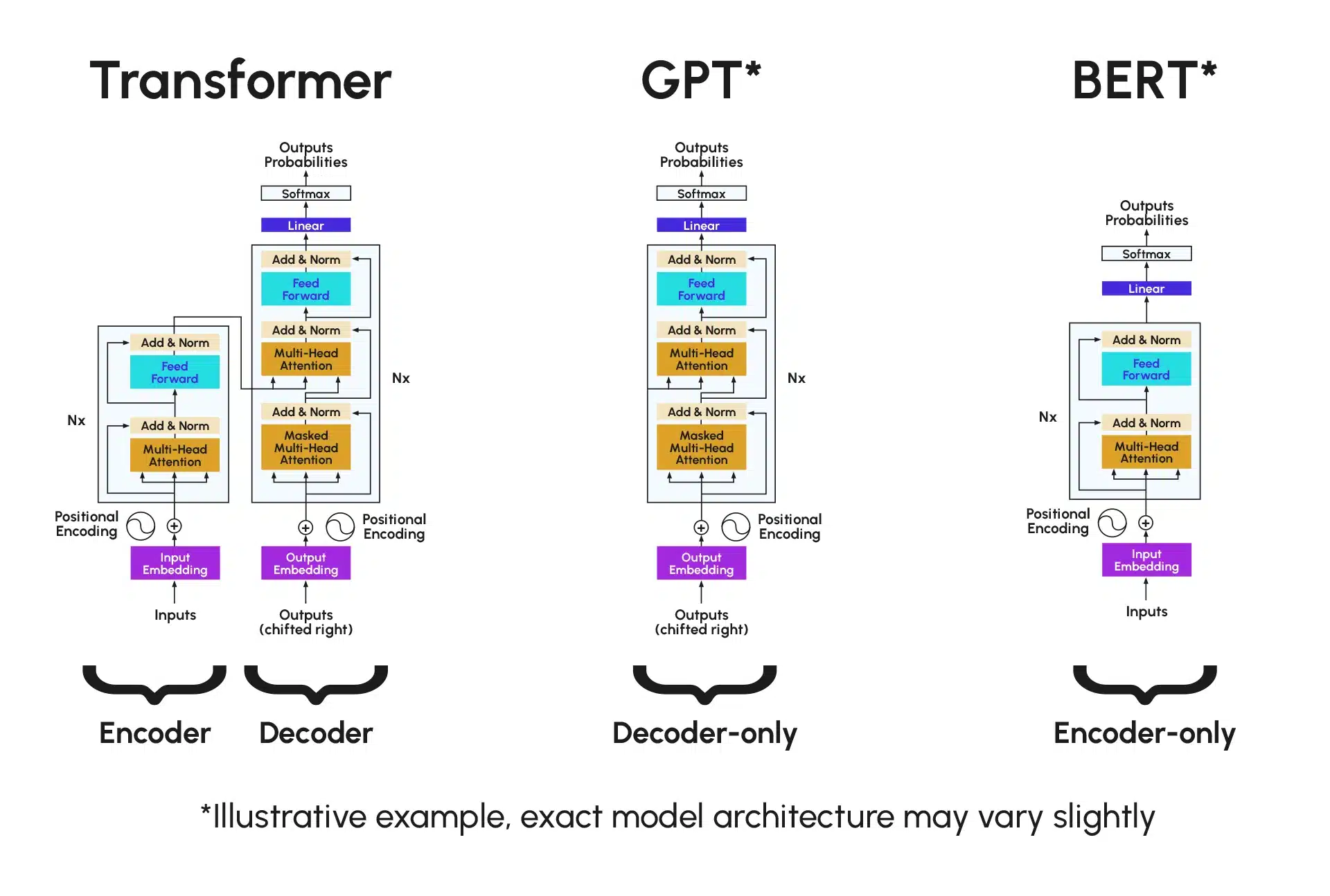
4. Encoder-Decoder
- Encoder: Processes the input to create a contextual representation.
- Decoder: Utilizes this representation and previous tokens to generate the output incrementally (e.g., translation).
How are Transformer Models applied?
Firstly, there is ChatGPT and LLMs. Generative Transformers (GPT, PaLM) generate coherent text by predicting the next token. ChatGPT, trained via reinforcement learning, excels in dialogue and content creation.
We also see contextual comprehension with BERT. Unlike GPT, BERT employs a bidirectional encoder to capture the global context. By 2019, it enhanced 70% of Google searches.
Additionally, there are Vision Transformers (ViT): by dividing an image into 16×16 patches, ViT rivals CNNs in classification, object detection, etc., thanks to its ability to model long-range relationships.
The figure below depicts the architecture of Transformers alongside GPT and BERT for comparison, both utilizing elements of the Transformer architecture:
What are the benefits of Transformer Models?
By parallelizing the processes, they become more efficient: by bypassing sequential processing, Transformers fully harness GPUs/TPUs, reducing training times by 50 to 80% compared to RNNs.
Their architecture allows for extensive pre-training on unlabeled corpora, such as Wikipedia or book contents. Models like BERT or GPT-3 achieve unprecedented performance thanks to hundreds of billions of parameters.
Originally crafted for NLP, Transformers today are versatile, expanding into:
- Computer vision: ViT (Vision Transformer) divides images into patches and processes them as sequences.
- Biology: analyzing DNA or protein sequences.
- Multimodal: models that integrate text, image, and sound, like DALL-E.
What are the constraints of Transformer Models?
First, we consider the computational and environmental cost: training models like GPT-3 consumes several megawatt-hours, raising ethical and ecological concerns.
Moreover, Transformers perpetuate the biases present in their training data, presenting significant risks when used for critical decisions, such as recruitment through resume filtering or medical decision support, as implicit biases can sustain and even amplify. Additionally, they can generate false yet plausible statements, such as fabricating nonexistent academic references or asserting a fictional event actually occurred. These statements are referred to as hallucinations.
An inevitable limitation is the complexity of interpretation. Indeed, attention mechanisms, although potent, remain “black boxes,” complicating the detection of systemic errors.
What are the future prospects?
The swift evolution of Transformers has profoundly influenced numerous fields, making research on optimization and reducing their energy footprint essential. Today, promising prospects regarding the use of Transformers include:
- Eco-Efficient Models: Exploring resource-efficient architectures prioritizing optimization of resource consumption (energy, memory, computing power, data volume…), like Sparse Transformers, or employing techniques like LoRA (Low-Rank Adaptation), which enables refining models without necessitating complete retraining.
- Multimodal AI: Seamlessly integrating text-image-video like GPT-4 or Gemini, which handle multiple modalities within a single model.
- Ethical Personalization: Adapting LLMs to specific needs without bias.
Conclusion
Transformers have revolutionized the field of AI, combining efficiency, versatility, and power. Confronting technical and ethical challenges, they remain fundamental to ongoing advancements, from virtual assistants to medical research and diagnostic tools. Their progression towards more responsible and less energy-intensive systems is likely to define the next decade of artificial intelligence.