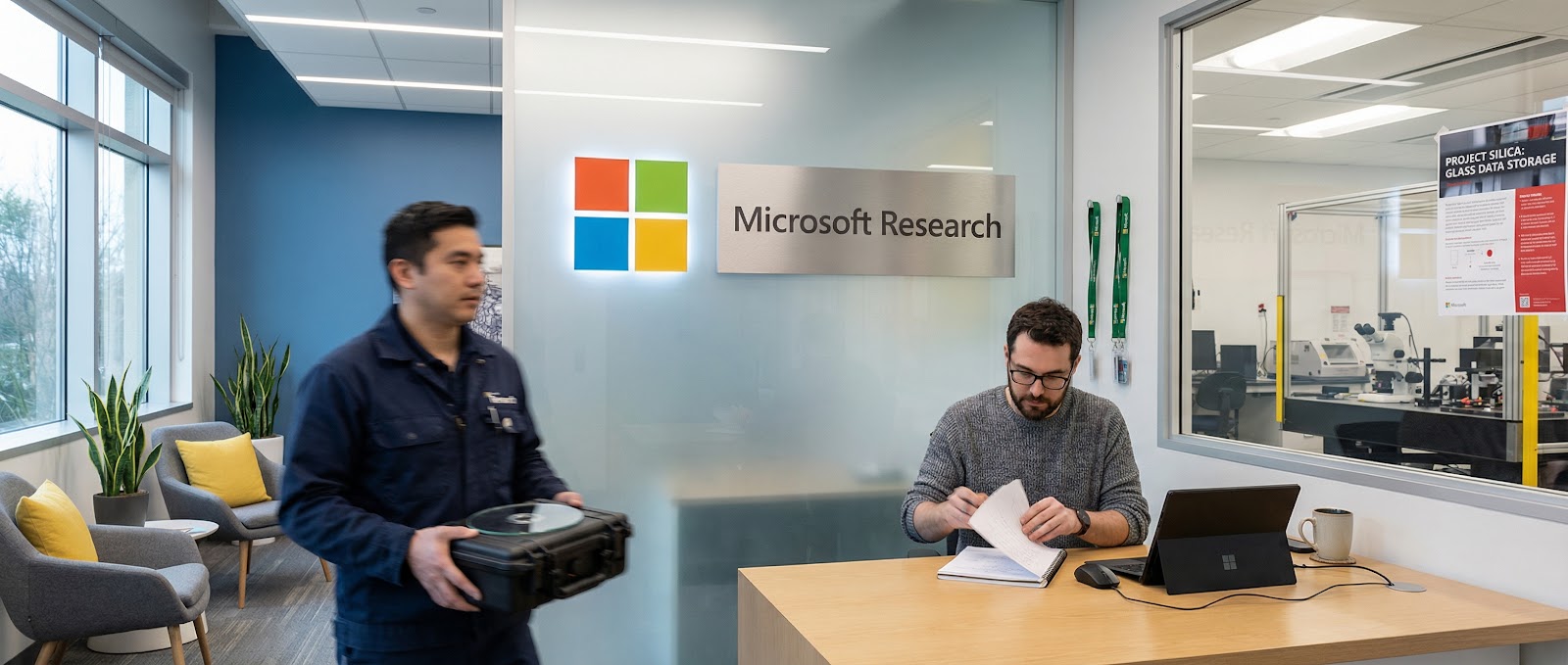
Microsoft announced a breakthrough in its Project Silica glass storage technology Tuesday, achieving 2.02 TB of data storage on a single glass platter that could preserve information for over 10,000 years. The advancement, published in Nature, uses common borosilicate glass instead of expensive fused silica, dramatically reducing costs while simplifying the laser-writing process that encodes data permanently into the glass structure.
The technology could revolutionize how organizations preserve digital information, potentially replacing magnetic tape systems that require costly migrations every few years. Microsoft Research confirmed that the “research phase is now complete,” signaling readiness to move toward commercial applications that could first appear in Azure data centers.
The key innovation lies in switching from complex “birefringent voxels” to simpler “phase voxels” that can be created with a single laser pulse, according to the Nature paper. This change allows the system to use standard Zernike phase-contrast microscopes for reading data rather than specialized polarization equipment, dramatically simplifying the hardware requirements.
Performance metrics revealed in the study show the system achieving 18.4 Mbit/s write speeds with a single laser beam, increasing to 65.9 Mbit/s with four parallel beams. The storage density reached 0.678 Gbit/mm³, enabling the 2.02 TB capacity on a single 120mm square platter just 2mm thick, Microsoft Research reported.
Market Impact and Cost Advantages
The shift to borosilicate glass, the same material used in common laboratory equipment-represents a crucial cost reduction. Data Center Knowledge reported that this material costs up to three times less than the high-purity fused silica previously required, addressing one of the technology’s main commercial barriers.
Microsoft has already demonstrated practical applications through partnerships with Warner Bros. and the Global Music Vault for cultural preservation projects, according to Microsoft Research. The technology targets the archival storage market currently dominated by LTO tape systems, offering a “write once, read forever” solution that eliminates periodic data migration costs.
The 10,000-year lifespan claim stems from accelerated aging experiments where researchers heated glass samples to temperatures between 440°C and 500°C, then extrapolated thermal degradation rates using the Arrhenius law. The Nature study calculated an activation energy of 3.28 eV, predicting the modifications would remain stable “for over 10,000 years at 290°C and therefore even longer at room temperature.”
Critical details about production costs per terabyte and data retrieval speeds remain undisclosed, leaving questions about immediate commercial viability. However, with the research phase complete, Microsoft appears positioned to transform how humanity preserves its digital heritage for future millennia.
Sources
- Nature
- Microsoft Research
- Data Center Knowledge