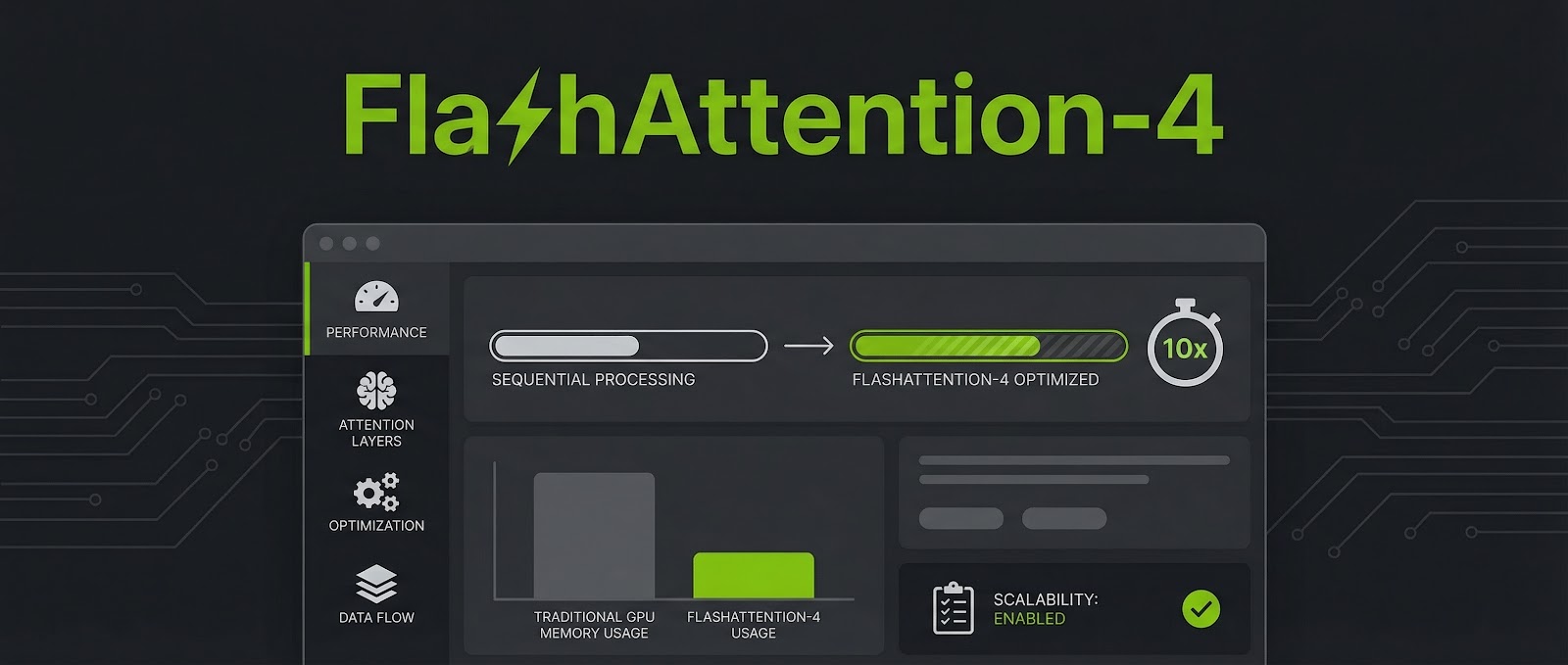
PyTorch has integrated FlashAttention-4 as a new backend for its FlexAttention API, delivering 1.2× to 3.2× speedups for custom AI attention mechanisms on NVIDIA’s Hopper and Blackwell GPUs. The update, detailed in a technical report released today, enables developers to write Python code that automatically compiles into highly optimized GPU kernels, eliminating the traditional trade-off between flexibility and performance in transformer model development.
The breakthrough leverages just-in-time (JIT) compilation to convert user-defined Python functions directly into CuTeDSL language kernels, according to the PyTorch Blog. This approach allows the system to access hardware features previously unavailable through standard frameworks, including programmer-managed Tensor Memory, asynchronous operations, and warp specialization on NVIDIA’s latest architectures.
The technology addresses a critical bottleneck in AI development where researchers have historically faced difficult choices between using fast but rigid pre-built kernels or flexible but slow custom implementations. FlexAttention with the new backend supports complex attention patterns including ALiBi, sliding window attention, document masking, and soft-capping, all while maintaining near-optimal performance.
Performance and Validation
Benchmarks demonstrate the FA4 backend matches or exceeds NVIDIA’s cuDNN attention performance in backward passes, though some gap remains in forward passes for standard causal attention, the PyTorch team reported. The implementation has been validated through large-scale testing, with a Llama 3 70B model trained on 64 H100 GPUs achieving identical final loss values using either the Triton or FA4 backend.
The performance gains stem from FA4’s ability to utilize deeply pipelined kernels and hardware-specific optimizations that keep tensor cores on Hopper and Blackwell GPUs fully utilized. These architectural advantages prove particularly valuable in compute-bound scenarios involving long sequence lengths, a common challenge in modern language models.
Current Limitations
The technology comes with important constraints for developers to consider. The backend exclusively supports NVIDIA Hopper and Blackwell GPUs, automatically defaulting to the Triton backend on other hardware. Additionally, the backward pass currently lacks determinism when block-sparsity is enabled, though the PyTorch team indicated a fix is in progress.
Other limitations include the inability to compute gradients for captured tensors such as learnable biases, and potential recompilation overhead when scalar values change between function calls. The kernel is also optimized for specific block sizes: 128×128 on Hopper and 256×128 on Blackwell, which may not suit all use cases.
Despite these constraints, the integration represents a significant advance for transformer model development, enabling researchers to experiment with novel attention mechanisms without sacrificing the performance needed for production deployment on modern data center GPUs.
Sources
- PyTorch Blog