
The model achieves its breakthrough performance through a sophisticated three-part architecture that combines a 16-block Conformer encoder, a specialized speech projector, and IBM’s pre-trained Granite language model with 128,000 token context length, according to the company’s technical documentation on Hugging Face. This design enables the system to process audio streams efficiently while maintaining accuracy typically associated with models twice its size.
Technical Innovation
IBM introduced several novel features that set Granite 4.0 1B Speech apart from competitors. The system incorporates keyword list biasing, allowing it to accurately recognize specific terms like company names and technical acronyms that often trip up standard speech recognition systems, according to IBM’s blog post. Additionally, the model employs speculative decoding to accelerate inference times, making it particularly suitable for real-time applications.
The model supports automatic speech recognition for English, French, German, Spanish, Portuguese, and Japanese, while offering bidirectional translation between English and these languages. IBM also added English-to-Italian and English-to-Mandarin translation capabilities, as detailed in the model card.
Enterprise Applications
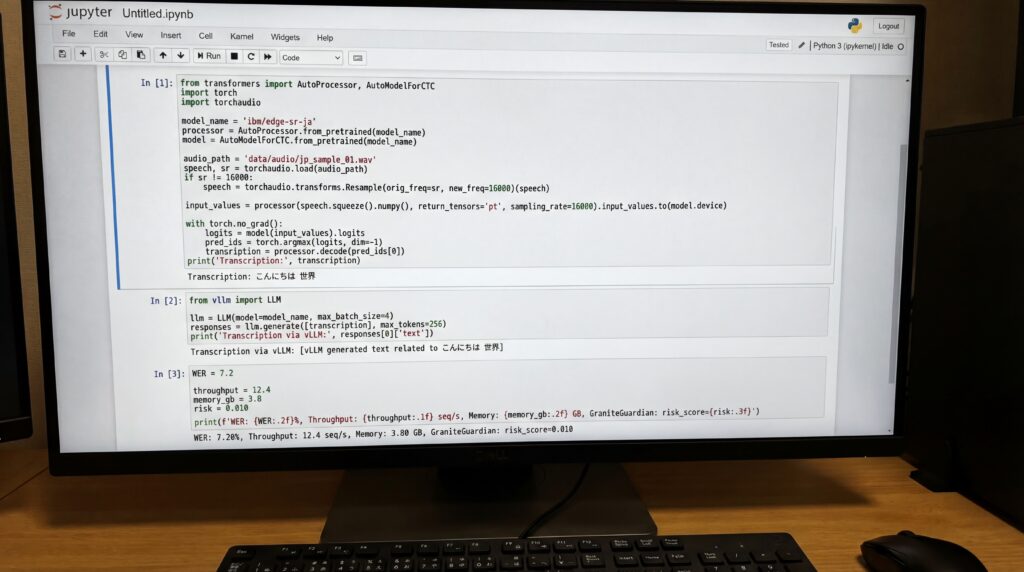
IBM specifically designed the model for business environments where computational resources are limited. The system runs natively in the popular transformers library and vLLM framework for high-throughput inference, according to the company’s documentation. This compatibility ensures developers can easily integrate the technology into existing workflows without extensive modifications.
For safety-critical applications, IBM built in safeguards that default to simple transcription when faced with malformed or adversarial inputs. The company recommends pairing the model with its Granite Guardian risk detection system for enhanced security in enterprise deployments, according to the technical specifications.
The training process combined publicly available datasets with synthetic data specifically generated to improve performance on Japanese speech recognition and domain-specific terminology, IBM reported. This hybrid approach allowed the company to achieve competitive Word Error Rate scores across standard English benchmarks while maintaining the model’s compact size suitable for edge deployment.