Google unveiled Groundsource in March 2026, an AI system that uses its Gemini language model to convert global news reports into structured data for predicting natural disasters. The technology has already analyzed millions of articles to create a public dataset of 2.6 million urban flash flood events across 150 countries, enabling forecasts up to 24 hours in advance.
The breakthrough system processes news articles in 80 languages using a sophisticated pipeline that transforms unstructured text into geo-tagged time-series data, according to the Google Research Blog. This approach solves a critical challenge in disaster management: traditional monitoring systems like satellites often miss rapid-onset events due to cloud cover and revisit limitations, while official databases typically capture only major disasters.
Groundsource operates through a multi-stage process powered by the Gemini model. The system first ingests global news reports where a disaster is the main topic, standardizes them into English via Google’s Cloud Translation API, then uses carefully crafted prompts to extract structured data including precise geocoding, event confirmation, temporal analysis, and data structuring.
Validation Shows Strong Performance
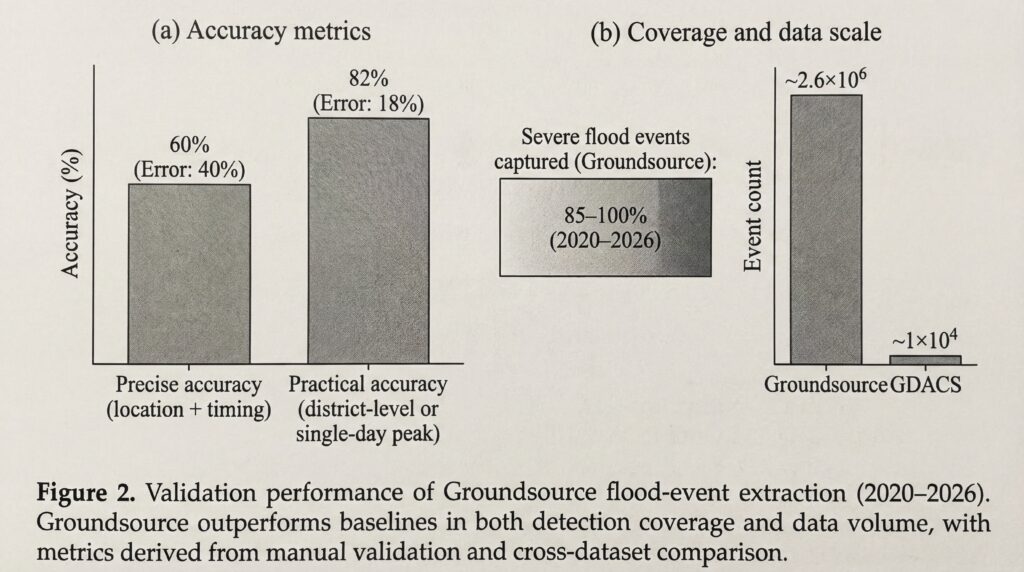
Manual review found that 60% of extracted flood events were accurate in both location and timing, while 82% were accurate enough for practical real-world analysis, such as correctly identifying the administrative district or event peak within a single day, Google Research Blog reported. These figures represent error rates of 40% for precise accuracy and 18% for practical utility.
When tested against the Global Disaster Alert and Coordination System (GDACS), Groundsource captured between 85% and 100% of severe flood events from 2020 to 2026. Remarkably, its 2.6 million documented events dwarf GDACS’s approximately 10,000 entries, demonstrating its ability to detect smaller, localized incidents that traditional systems miss.
Immediate Impact and Future Applications
The dataset has already enabled Google’s Flood Hub to expand its predictive coverage to near-global levels for urban areas, providing forecasts up to 24 hours in advance, according to Google AI. By making the flash floods dataset openly available, Google empowers researchers worldwide to develop their own disaster prediction models.
The company plans to extend the technology beyond flash floods to create historical datasets for droughts and landslides, potentially revolutionizing how scientists and emergency managers prepare for multiple types of natural disasters. This text-based approach represents a paradigm shift in earth sciences, turning the world’s news archives into a continuously updating sensor network for disaster monitoring.
Sources
- research.google/blog
- ai.google