
Google Cloud unveiled AI-powered enhancements to its Sensitive Data Protection service throughout 2024-2025, introducing context-aware classifiers and image object detectors that can identify medical records, financial invoices, and redact faces, passports, and photo IDs in images. The new features, which move beyond traditional pattern matching to understand data meaning and context, are now available across global regions and integrate with Google’s broader cloud ecosystem including Vertex AI.
The upgrades enable Google Cloud‘s Sensitive Data Protection (SDP) service to distinguish between medical conversations and technical support queries, automatically applying appropriate security protocols based on context. According to Google Cloud, the system can now differentiate between phrases like “My arm is broken and I can’t use the touchscreen” and “My wifi is broken,” treating the former as sensitive medical information.
The context-aware classifiers, announced in August 2025 and now available across global, Asia, Europe, and US regions, can identify entire document types including financial invoices and medical records. This represents a significant departure from traditional security tools that rely solely on pattern matching to spot sensitive data.
Google Cloud also released image object detectors capable of identifying and redacting faces, passports, and photo ID cards within images. The passport and photo ID detectors launched in November 2025 as generally available features, while the face detection capability, announced in December 2025, remains in preview mode across all major regions, according to Google Cloud’s release notes.
Integration with AI Ecosystem
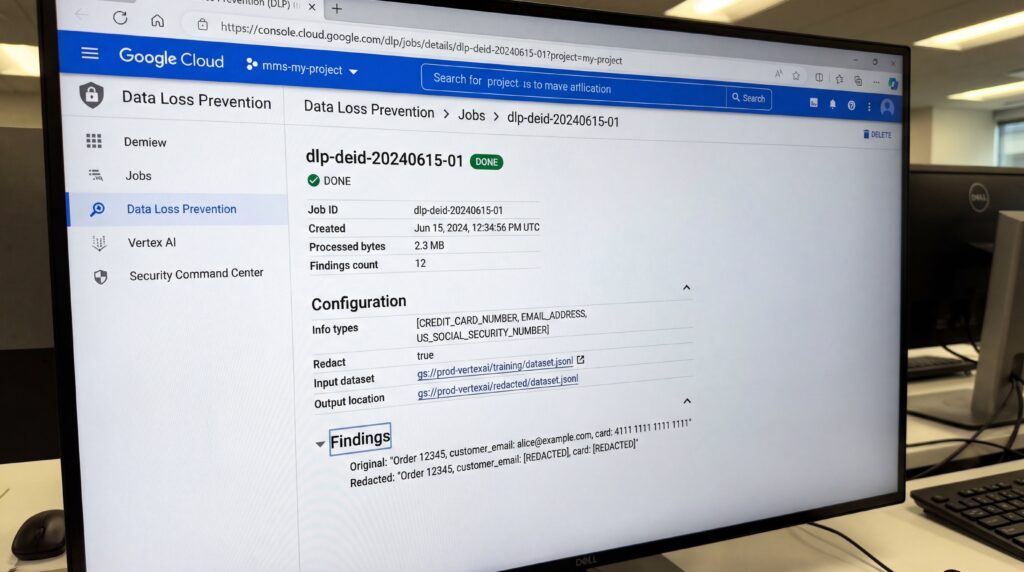
The enhanced SDP service integrates directly with Vertex AI, scanning and redacting sensitive information from data used to train models like Gemini, Google Cloud reported. The system also powers security guardrails in Model Armor and Security Command Center, while protecting real-time customer interactions in Contact Center as a Service.
In practical applications, the technology can automatically obscure faces in product damage photos used for AI training while preserving the relevant visual data. The context-aware system reduces false positives by distinguishing between non-sensitive order numbers and sensitive financial information, redacting only when necessary.
The upgrades address growing concerns about privacy protection as organizations increasingly rely on unstructured data and generative AI. By understanding context rather than just detecting patterns, the system offers more sophisticated data governance for enterprises navigating complex compliance requirements.
However, Google Cloud has not released quantitative metrics on accuracy rates, performance benchmarks, or false positive rates for these features, leaving potential users without key evaluation criteria. Details about the underlying AI models, data residency specifications, and pricing structures also remain undisclosed.
Sources
- cloud.google.com/blog
- docs.cloud.google.com