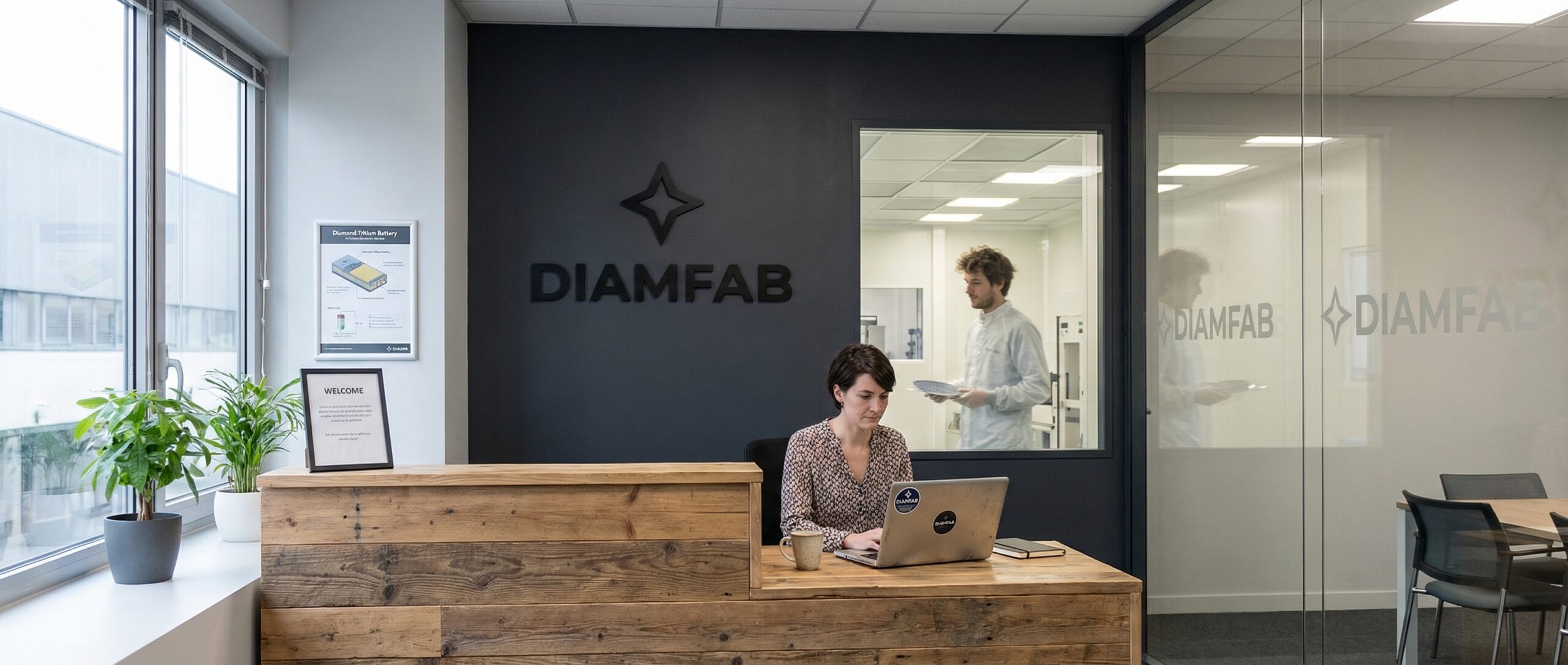
French startup Diamfab has successfully developed a prototype nuclear battery that runs for 20 years without maintenance, partnering with STMicroelectronics and France’s Atomic Energy Commission. The breakthrough device uses synthetic diamonds to convert radioactive tritium decay into electricity, with pilot production now underway in Isère targeting space exploration and other high-value markets by 2026.
The Tbatt-Diamond project represents a significant advancement for France’s nuclear battery sector, with the consortium achieving a functional prototype that demonstrates 10.5% conversion efficiency and an energy density of 15 nW/cm², according to Nuclear Valley. The team aims to boost power density to 100 µW/cm³ by optimizing the design and increasing the radioactive source intensity.
The betavoltaic technology converts beta particles from tritium’s radioactive decay directly into electricity, similar to how photovoltaic cells convert light into power. Diamfab’s synthetic diamonds serve as wide-bandgap semiconductors, offering crucial advantages including radiation resistance and the ability to operate at higher temperatures than silicon-based components, eliminating the need for heavy cooling systems in weight-sensitive applications.
Strategic Industry Collaboration
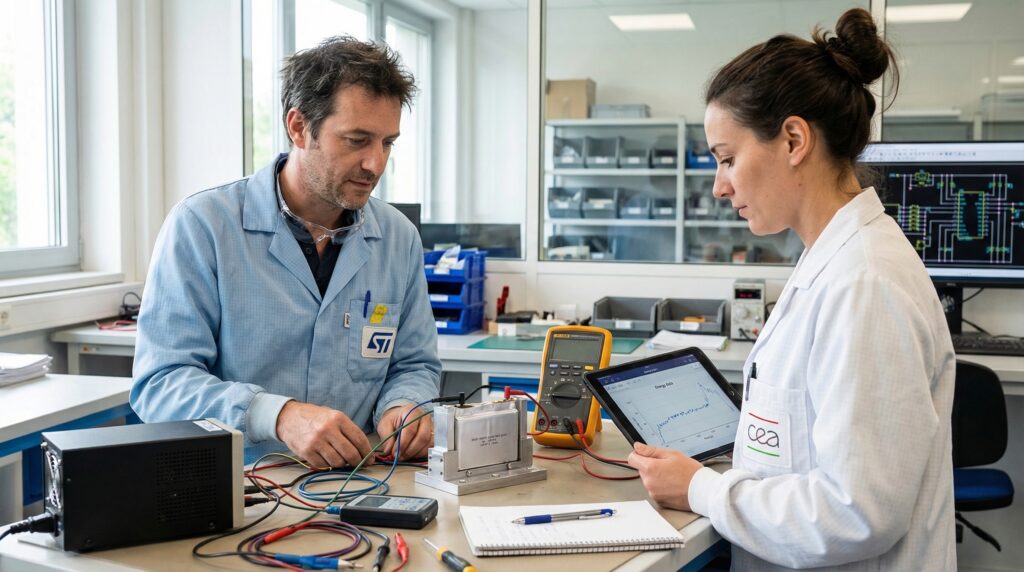
STMicroelectronics brings semiconductor design and large-scale manufacturing expertise to the partnership, while the CEA (Commissariat à l’énergie atomique et aux énergies alternatives) provides critical knowledge in nuclear materials and tritium management. This collaboration positions France at the forefront of nuclear battery development, with L’Embarqué calling it “a first” for the country’s technology sector.
The company has already begun working with the European Space Agency (ESA) to develop more powerful generators for space exploration missions. The batteries’ extreme reliability makes them ideal for powering sensors, onboard systems, and microsatellites in harsh environments where maintenance is impossible.
Market Timeline and Regulatory Challenges
Diamfab plans to scale production to 4-inch diamond wafers by 2026, with initial commercial applications expected in 2026-2027 for industrial and medical fields, according to La Tribune. The space sector deployment is targeted for post-2028, with aerospace and defense integrators representing key potential clients.
The technology faces significant regulatory hurdles due to tritium’s classification as a radioactive material, requiring strict authorizations from nuclear safety authorities. As a dual-use technology with both civil and military applications, exports will be subject to stringent controls under international agreements like the Wassenaar Arrangement. The project’s positioning as a sovereign solution suggests strong support from French and European state actors will be crucial for navigating these complex regulatory landscapes.
Sources
- https://www.nuclearvalley.com
- https://www.lembarque.com