Databricks announced Wednesday it has acquired Quotient AI, a startup that specializes in evaluating and improving artificial intelligence agents in production environments. The deal, whose financial terms were not disclosed, will integrate Quotient’s testing and reinforcement learning technology into Databricks’ AI platform to help enterprises build more reliable automated systems.
The move brings together Databricks, a leader in data and AI platforms, with a team of engineers who previously led quality improvements for GitHub Copilot, according to a Databricks blog post. The acquisition addresses a critical challenge facing enterprises as they deploy AI agents: the complex failure modes that emerge in production, including hallucinations, flawed reasoning, and incorrect tool usage.
Quotient AI’s technology analyzes complete agent traces in production environments to identify performance issues and automatically clusters failure signals into structured evaluation datasets. These capabilities will be embedded directly into Databricks’ agentic offerings including Genie, Genie Code, and Agent Bricks, the company said in its announcement.
The platform uses reinforcement learning models to diagnose root causes of agent failures and creates feedback loops that enable organizations to systematically improve agent behavior over time, according to SiliconANGLE. This approach allows AI systems to learn from real-world interactions and become domain specialists rather than remaining static after deployment.
Competitive Positioning
The acquisition positions Databricks to compete more aggressively against rivals like Hugging Face and OpenAI in the AI platform market. While competitors offer model evaluation tools, Databricks will now provide a tightly integrated continuous feedback loop within its data and AI platform, which industry observers note as critical for enterprise adoption.
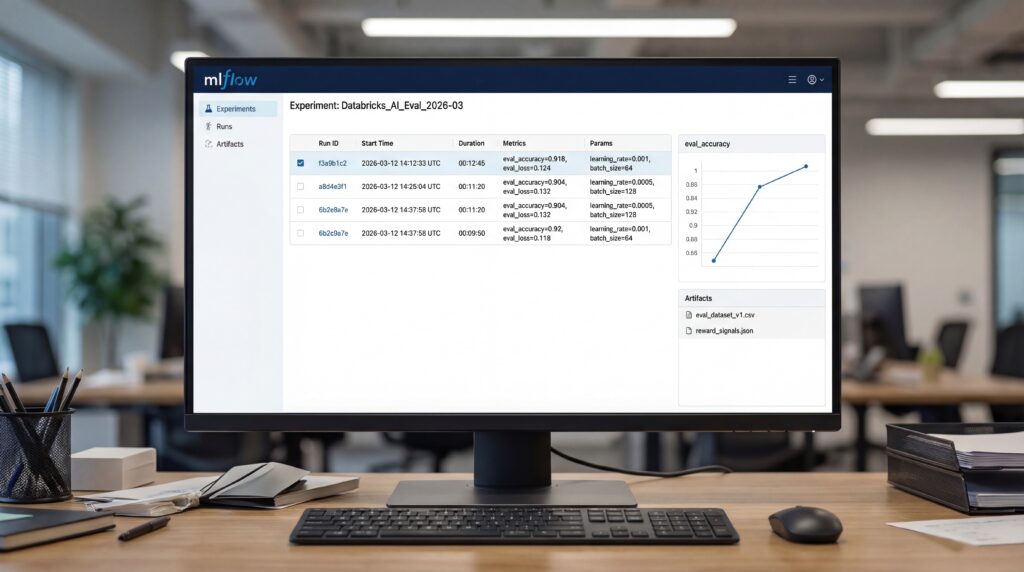
Integration plans include embedding the evaluation datasets and reward signals into MLflow, Databricks’ AI lifecycle management framework, and enabling AI agents to operate within the secure environment of the Databricks Lakehouse, according to the company’s blog post. This allows organizations to leverage their specific data context and security protocols while continuously improving agent performance.
Enterprise Impact
For enterprises deploying AI agents, the technology promises to reduce the gap between development and reliable production performance. The automated evaluation and improvement capabilities address what has been a manual and resource-intensive process for many organizations attempting to maintain AI quality at scale.
The acquisition signals Databricks’ commitment to solving post-deployment challenges that have slowed enterprise AI adoption. By bringing sophisticated evaluation and reinforcement learning capabilities in-house, the company aims to provide customers with AI systems that become more accurate and specialized over time through systematic improvement based on production feedback.
Sources
- databricks.com/blog
- siliconangle.com