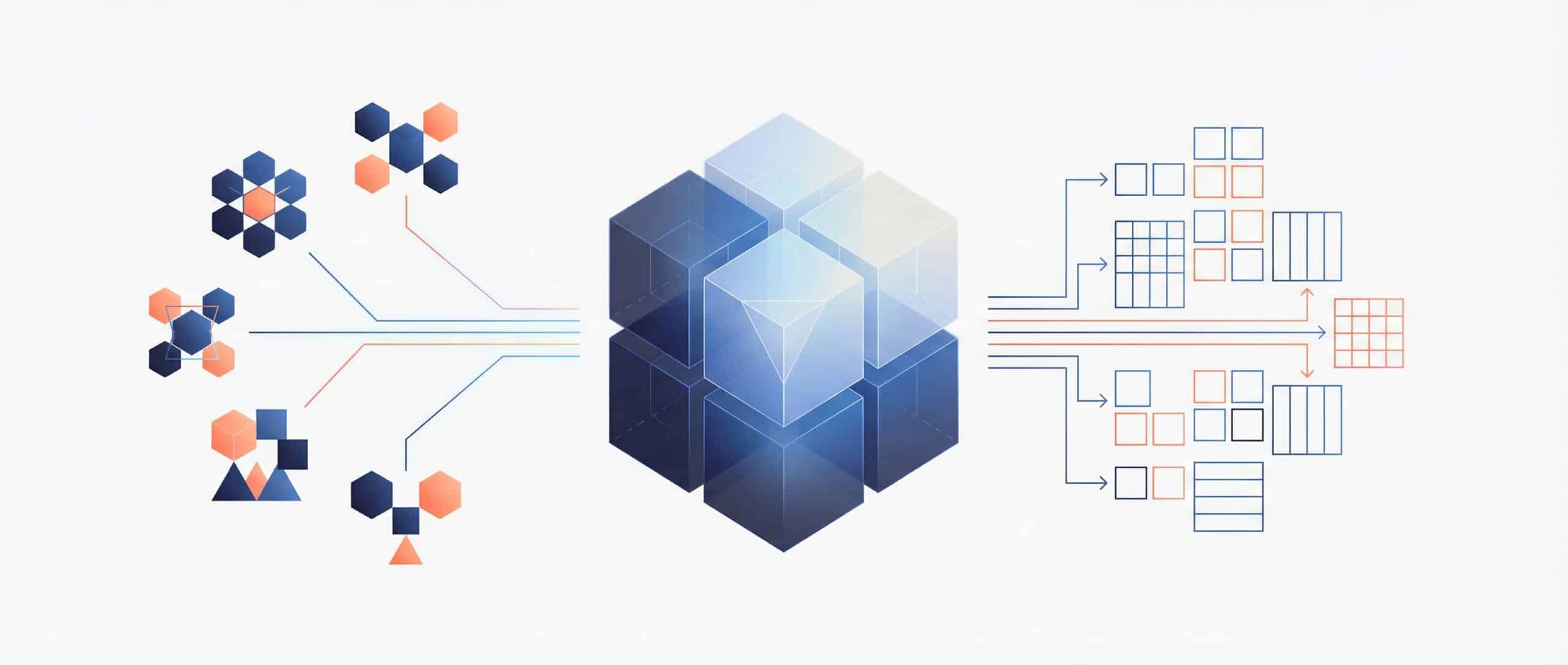
A Data Warehouse allows you to collect data from various sources and analyze them. Discover everything you need to know about this technology at the heart of Data Science: definition, operation, history, use cases, training…
What is a Data Warehouse ?
A data warehouse is a platform used to collect and analyze data from multiple heterogeneous sources. It occupies a central position within a Business Intelligence system.
This platform combines several technologies and components that enable data to be used. It allows the storage of a large volume of data, but also the query and analysis. The objective is to transform raw data into useful information, and to make it available and accessible to users.
A data warehouse is usually separated from the operational database of a company. It allows users to draw on historical and current data to make better decisions.
The term “Data Warehousing” refers to the process of collecting and managing data from various sources in order to extract valuable information that can be used by the company.
A data warehouse can have two different statuses.
- Offline : The data is copied from an operational system to another server. The loading, processing and reporting of the data does not impact the performance of the OS.
- Online : The data is regularly updated from the operational database. In the case of a real-time data warehouse, the data is updated every time a transaction takes place in the relational database. An example of this is a train or plane reservation system.
Finally, in the case of an integrated data warehouse, the data is updated continuously. The generated transactions are transferred back to the operating system.
How did the concept of the Data Warehouse appear ?
Over time, computers have become more complex. The amount of data available to businesses has increased dramatically. Therefore, data warehouses have become indispensable.
In 1970, Nielsen and IRI first introduced the concept of dimensional data marts for retail. In 1983, Teradata launched a database management system specifically designed for decision support.
However, it was not until the late 1980s that the first enterprise data warehouse emerged, developed by Paul Murphy and Barry Devlin of IBM.
How does a data warehouse work ?
A data warehouse works like a central repository. The information comes from one or more data sources, such as a transactional system or other relational databases.
The data can be structured, semi-structured or unstructured. Once ingested into the Warehouse, it is processed and transformed. Users can then access it using business intelligence tools, SQL clients or spreadsheets.
By aggregating information in one place, a company can gain a comprehensive view of its customer base or other critical elements. Warehousing ensures that all information is reviewed.
In addition, the data warehouse makes data mining possible. This process involves looking for trends and patterns in the data and building on them to increase sales and revenue for the company.
What are the different types of Data Warehouses ?
There are three main categories of data warehouses. First of all, the “Enterprise Data Warehouses” (EDW) are centralized data warehouses that support the company’s decisions. Data is organized and presented in a unified way. EDWs also allow data to be classified according to their subject matter.
The second major category of data warehouses is the Operational Data Stores (ODS). Data is updated in real time, which is very useful for day-to-day activities such as saving reports and employee records.
Finally, a Data Mart is a sub-category of Data Warehouse. It is designed for companies in the sales or financial sectors. The data can be collected directly from the different sources.
The different components of a data warehouse
A data warehouse is based on three main components :
The load manager allows all data extraction and loading operations to the warehouse. It is also in charge of data transformation.
The Warehouse Manager performs operations related to data management within the warehouse. In particular, it ensures data consistency, the creation of indexes and visualizations, the transformation and merging of data from several sources and archiving.
The query manager performs operations related to the management of user queries by directing them to the appropriate tables. Finally, the access tools allow end users to interact with the data warehouse. These tools can be used for reporting, querying, application development or data mining.
Who uses a data warehouse ?
Data Warehouses are used by all companies with large volumes of data to process, or collecting data from multiple sources. They are also used by companies that want to access data more easily.
For any company wishing to take advantage of decision support, data warehouses can be relevant. This is also the case for users looking to manage reports, graphs or charts from data. However, they are used in different ways depending on the industry.
In the airline industry, airlines use them to analyze the profitability of routes, or to offer personalized promotions.
Banks use data warehousing to manage resources, conduct market research, or analyze the performance of their various products.
In healthcare, data warehouses are used to predict treatment outcomes, produce patient reports and share data with insurance companies.
The public sector uses this technology to collect data, or to analyze reports on taxes or health policy. In the insurance industry, it is used to analyze market trends or customer behavior.
Retail chains use data warehouses for distribution and marketing, inventory, logistics, to understand consumers and to optimize prices or launch personalized promotional campaigns.
The same is true for the telecom sector where sales and distribution decisions are based on data, as are promotional campaigns. Finally, in the tourism and hotel industry, advertising and promotional campaigns can be based on travelers’ preferences and habits.
Advantages and disadvantages of data warehouses
Data warehouses have their advantages and disadvantages. They are very useful in allowing companies to quickly and easily access data from multiple sources in a centralized manner.
With these tools, it is possible to access consistent and up-to-date information about all the company’s activities. They also allow you to generate reports and perform queries to interrogate the data.
In general, a data warehouse reduces the time needed for data analysis and reporting and makes these tasks easier. Finally, with large volumes of historical data, users can analyze trends over different time periods to makepredictions for the future.
However, data warehouses also have their drawbacks. First of all, it is not an ideal solution for unstructured data. In addition, creating and implementing a data warehouse is time-consuming and often requires a lot of work. Paradoxically, a warehouse can quickly become obsolete.
Furthermore, it is difficult to make changes in data types, data source schemas, indexes and queries. Using such a platform can be too complex for the average user.
As a result, organizations must deploy many resources to train employees and implement the Warehouse. It is therefore important to weigh the pros and cons before deciding to use this type of solution.
How to learn how to use a data warehouse ?
To learn how to use a Data Warehouse, you can turn to the Liora training courses. You can discover how to master these tools through our different programs: Data Scientist, Data Analyst,Data Engineer…
The Data Warehouse is at the heart of the data science professions, and our different courses offer you the opportunity to learn how to use them. For example, you can discover Snowflake, the Data Warehouse available on the Cloud.
Our training courses adopt an innovative Blended Learning approach, a hybrid between face-to-face and distance learning, and can be taken as an intensive BootCamp or as Continuing Education. They lead to a degree certified by the Sorbonne University.