AWS Fargate is a compute engine for Amazon Elastic Container Service (ECS) and Amazon Kubernetes Service (EKS) that enables containers to run without the need to provision, configure and scale virtual machine clusters that host application containers.
Fargate allows you to eliminate the manual management of EC2 instances. As a result, you can focus your efforts on designing and building your applications instead of managing the infrastructure that runs them. All you need to do is package your applications in containers, specify your memory and processor requirements, define IAM policies, and launch your applications.
Terms you need to know to use AWS FargateTermes à connaître pour utiliser AWS Fargate
First and foremost, we need to familiarize ourselves with certain terms:

Container (conteneur): A Docker container is the standard unit that will contain everything your application needs to run (database, environment variables, libraries, etc.).

Container Image (image de conteneur): Images are built from a Dockerfile that specifies all the components that will be included in the container. These containers are created from a container image template.

Task Definition (définition de tâche): These are JSON-format files that define the container(s) that make up your application.

Task (tâche): A task is nothing more than the instantiation of a task definition within a cluster.

Clusters: It is essentially the logical grouping of resources that your application needs.
Familiarize yourself with the AWS environment
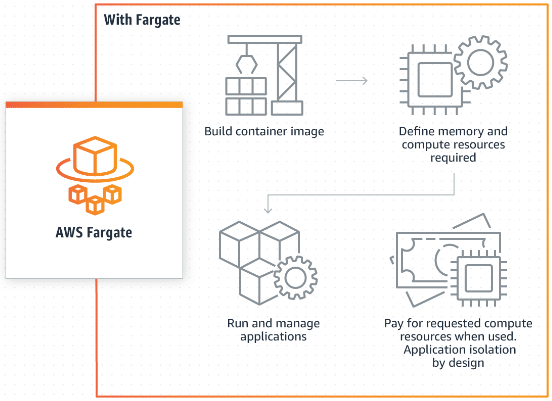
Now, let’s try to understand the diagram above.
First, you build an image suitable for your application. Then, you define the various required resources such as memory, processor, etc., as well as the orchestration engine you want to use (ECS or EKS). Finally, you can run and manage your different applications, paying only for usage and the resources used.
Dans quels cas utiliser AWS Fargate ?
While Fargate supports all common use cases for containerized applications such as microservices architecture, batch processing, scripts, web applications, or machine learning applications, there are some cases where its usage is particularly beneficial.
Fargate is an ideal solution for running microservices. You can deploy each containerized microservice, and the necessary resources will be automatically managed.
Fargate can be used for batch processing tasks, such as image and video processing, data analysis, and ETL tasks. You can adjust your requirements based on the necessary workload.
Deploying and running web applications can be easily accomplished with Fargate. This allows you to scale it as the demand from your users increases.
You can use Fargate to automate your entire DevOps process and pipelines.
En conclusion
As you’ve understood, AWS Fargate provides a serverless computing solution for containerized applications, enabling straightforward and efficient management of the resources they require.
With this solution, you can focus on developing your applications while the platform takes care of the underlying compute resources. With its discussed advantages, it is a wise choice for businesses of all sizes seeking a modern approach to application deployment and development.
Now that you are well-informed about AWS Fargate, you can consider taking a training course to master Amazon Web Services. To do so, explore the training offered by Liora.