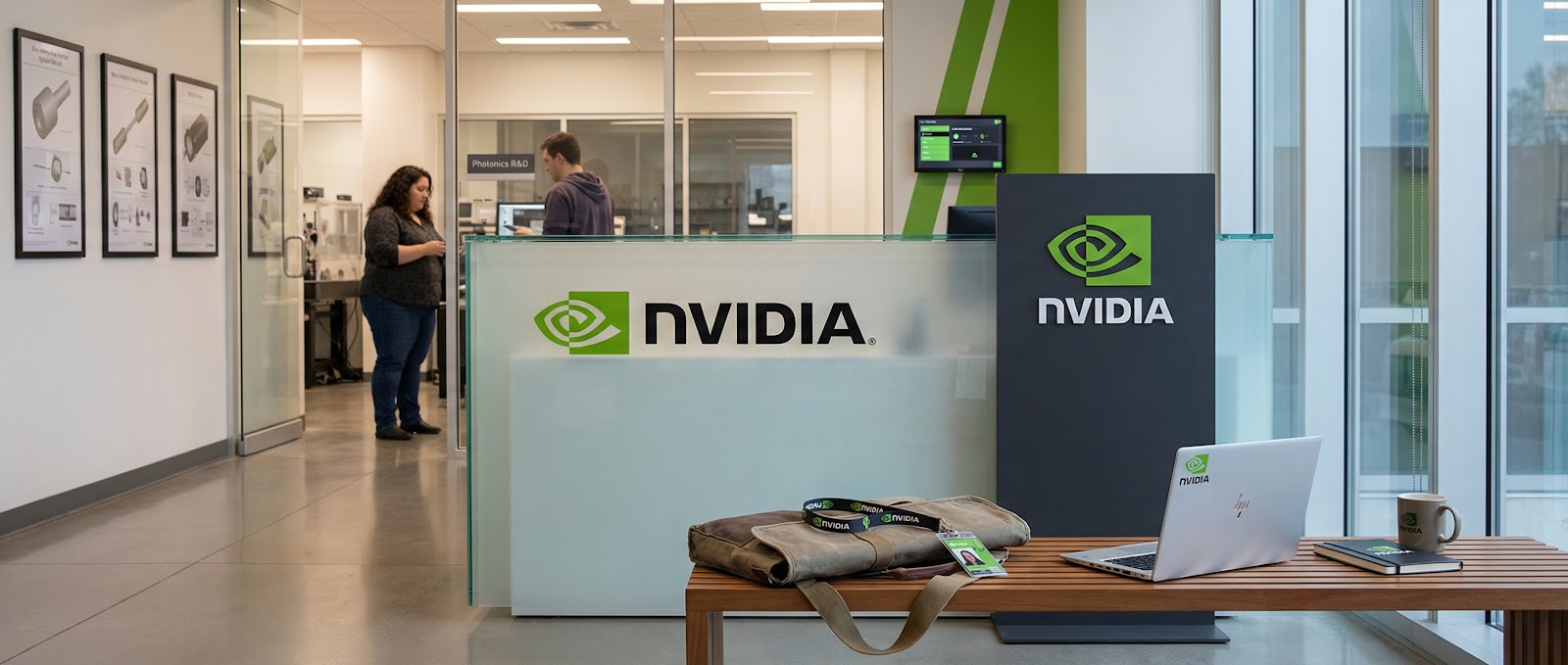
Nvidia announced $4 billion in strategic investments Monday, committing $2 billion each to optical technology firms Lumentum and Coherent to develop advanced photonics components critical for next-generation AI data centers. The multi-year agreements, which sent both partners’ stocks surging in premarket trading, include multi-billion dollar purchase commitments and secure Nvidia’s access to future optical networking capacity as it races to build massive “gigawatt-scale AI factories”.
The partnerships mark a pivotal shift in how Nvidia approaches the fundamental challenge of data movement in artificial intelligence systems. The agreements focus on developing advanced laser components and next-generation silicon photonics that can link tens of thousands of GPUs within a single facility, according to Nvidia’s press releases.
For Lumentum, Nvidia’s investment takes the form of Series A convertible preferred stock, as disclosed in SEC filings. The funding will support scaling production of advanced laser components essential for high-speed optical transceivers. Coherent will use its allocation to advance laser and optical networking products, with both companies expanding their U.S.-based manufacturing capabilities.
The market responded enthusiastically to the announcement. Lumentum Holdings stock rose 8 percent in premarket trading on March 2, 2026, while Coherent Corp. gained 6.5 percent, according to Investopedia and Alphaspread reports.
Strategic Imperative
The investment addresses a critical bottleneck in AI infrastructure development. Traditional electrical interconnects cannot handle the bandwidth requirements of massive AI models while maintaining reasonable power consumption. Optical interconnects offer the only viable path to achieving the scale CEO Jensen Huang envisions for future AI systems.
This move extends Nvidia’s vertical integration strategy, following its 2019 acquisition of Mellanox. By directly funding component suppliers, the company secures reliable access to critical technologies while influencing their development roadmaps, according to company statements.
Energy efficiency represents another key driver. Optical interconnects consume significantly less power than copper-based alternatives for high-bandwidth transmission, helping reduce operational costs and environmental impact of large-scale AI platforms.
Market Implications
The deals intensify pressure on competitors including Broadcom, Intel, Marvell, and Cisco, who may need to forge similar partnerships to avoid disadvantages in securing high-performance optical components. The investments could accelerate market consolidation and create potential vendor lock-in scenarios for customers.
However, the strategy carries risks. Concentrating supply chain dependencies on two key partners creates vulnerability to manufacturing disruptions. The scale of these investments and purchase commitments may also attract regulatory scrutiny regarding Nvidia’s growing market power. Technical challenges in developing advanced photonics and aligning roadmaps across three companies could impact execution timelines.
Sources
- NVIDIA Newsroom
- Investopedia