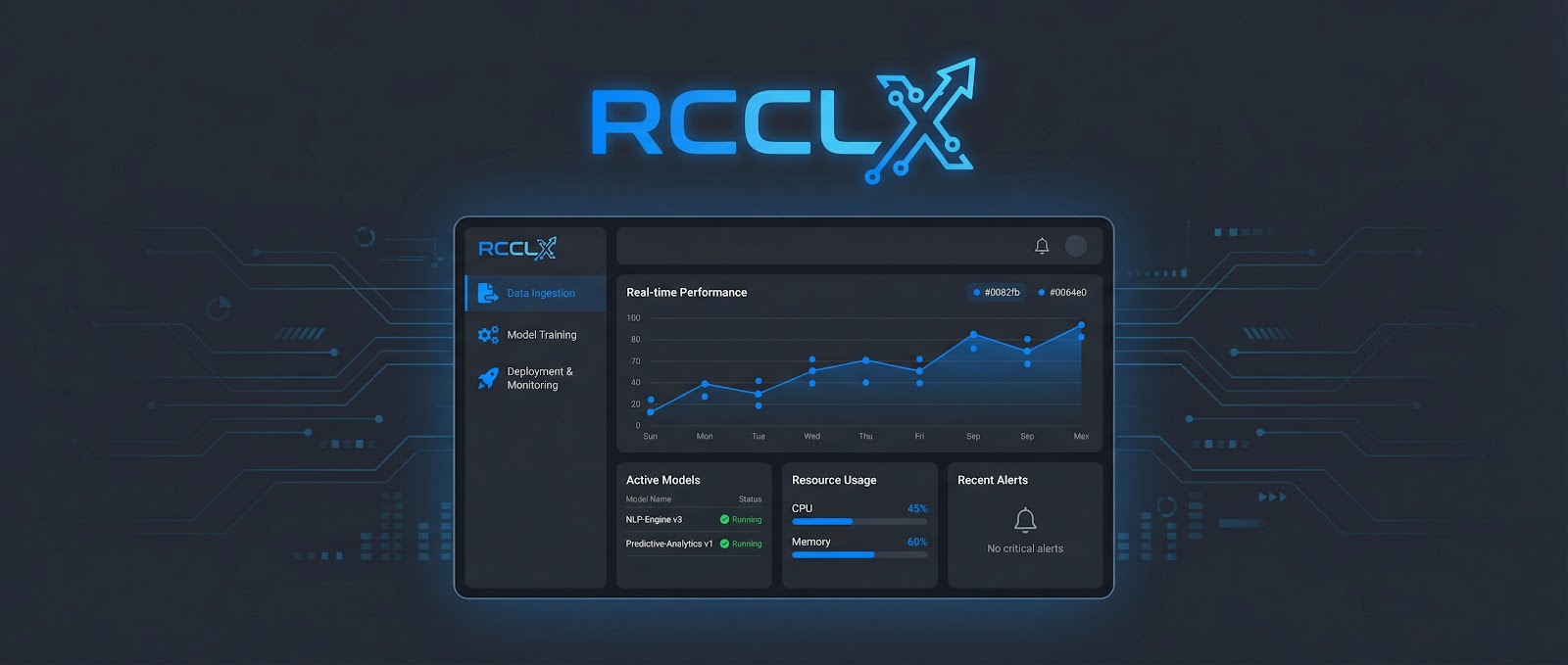
Meta released RCCLX, an open-source upgrade to AMD’s GPU communication software, on February 24, 2026, delivering up to 50% faster performance for AI and large language model workloads. The enhancement integrates Meta’s custom CTran transport layer with AMD’s RCCL library, introducing GPU-resident collectives and other advanced features that significantly accelerate PyTorch-based AI computations.
The breakthrough comes at a critical time for AMD as it competes with NVIDIA for dominance in the AI accelerator market. RCCLX addresses longstanding performance bottlenecks in AMD’s communication stack that have limited its adoption for large-scale AI training, according to Meta Engineering.
The software introduces three core innovations that drive the performance gains. GPU-resident collectives allow graphics processors to manage communication operations directly without host intervention, dramatically reducing latency. Direct Data Access algorithms specifically target AllReduce operations, achieving 10-50% speedups for decode phases and 10-30% improvements for prefill phases in language model inference, Meta reported.
Perhaps most notably, the new low-precision collectives use FP8 quantization to compress data transfers by up to 4:1 while maintaining computational accuracy in FP32. This feature alone provides significant acceleration for large message transfers on AMD’s MI300 and MI350 series GPUs, according to benchmarks published by Meta.
Market Impact and Adoption
The release strengthens AMD’s position in the competitive AI hardware landscape by removing a key software disadvantage. RCCLX integrates seamlessly with PyTorch through the Torchcomms project, making adoption straightforward for developers already using Meta’s AI framework.
Available under a BSD 3-clause license on GitHub, the software requires AMD’s ROCm versions 6.4 or 7.0 and is optimized for the company’s latest Instinct MI300X, MI325X, and MI350X accelerators. Developers can activate the enhancements by building Torchcomms from source with specific environment variables, Meta’s documentation states.
The timing appears strategic, as demand for AI infrastructure continues to surge globally. By open-sourcing these optimizations, Meta enables the broader AI community to achieve better performance on AMD hardware, potentially accelerating adoption beyond its own data centers.
Meta indicated plans to continue developing RCCLX to achieve feature parity with NCCLX, its NVIDIA equivalent. The company describes Torchcomms as “experimental,” signaling ongoing evolution as the AI ecosystem’s needs expand. The project remains open to community contributions, positioning it for collaborative development as more organizations deploy AMD GPUs for AI workloads.
Sources
- Meta Engineering