
The volume of data generated and used by companies continues to grow exponentially. In this context, the efficient structuring and organization of this data for optimal analysis is of paramount importance.
Dimensional modeling is an inescapable solution to this challenge. It is a methodological approach to the design of data warehouses. Ralph Kimball, a pioneer and expert in business intelligence, established standards and principles that today guide many organizations in the design and operation of their information systems.
Kimball’s fundamental principles
The Kimball method is based on a series of key principles that define how data should be structured and organized to facilitate its analysis and exploitation.
These principles form the basis of dimensional modeling, providing a clear and systematic framework:
1. Tables et dimensions
- Definition: Dimension tables contain descriptive attributes of data. They provide the necessary context to understand and interpret the quantitative measures contained in fact tables.
- Key characteristics:
- Textual and descriptive attributes.
- Often denormalized to optimize query performance and simplicity.
- May contain hierarchies to facilitate analysis at different levels of granularity.
2. Tables de faits
- Definition : Fact tables store quantitative or metric measurements that are usually the result of a transaction or event.
- Main features :
-
- Contain metrics such as sales, quantity, cost, etc.
- Linked to dimension tables via foreign keys.
- May include composite keys to uniquely identify a record.
3. Granularity
- Definition : Granularity refers to the level of detail or summary of the data stored in the fact table.
- Importance :
- Determining granularity is crucial as it influences how data is collected, stored and analyzed.
- It must be defined according to business needs and the questions for which the Data Warehouse is supposed to have the answers.
4. Standardization vs. denormalization
- Normalization : The process of structuring data to reduce redundancy and improve integrity. It is often used in transactional database management systems.
- Denormalization : The process of structuring data to improve query performance, often at the expense of redundancy. It is favored in dimensional modeling to facilitate data analysis.
Kimball’s method, with its principles of dimension and fact tables, provides a solid framework for data warehouse design. By understanding and applying these basic principles, organizations can create information systems that are robust, flexible and optimized for analysis.
Advantages of the Kimball Method
Kimball’s dimensional modeling approach didn’t just happen to make its way into data warehousing. Its distinctive advantages make it a preferred approach for many organizations.
| Key benefit | Description | |

|
Optimal performance for queries | Even with large volumes of data, this approach enables fast queries, improving end-user experience when generating reports or dashboards. |

|
Flexibility | New dimensions or facts can be added without impacting the existing structure, making the data warehouse easier to evolve with business needs. |

|
Ease of understanding | The clear separation between dimensions (context) and facts (measures) makes the model intuitive, even for non-technical users. |

|
Scalability | The dimensional structure is designed to handle growing data volumes without compromising performance. |

|
Data consistency and integrity | A well-defined dimensional model improves data quality and makes inconsistencies or anomalies easier to detect. |

|
Cost reduction | Although initial setup may require investment, easier maintenance and scalability often lead to significant long-term cost savings. |
Kimball design process
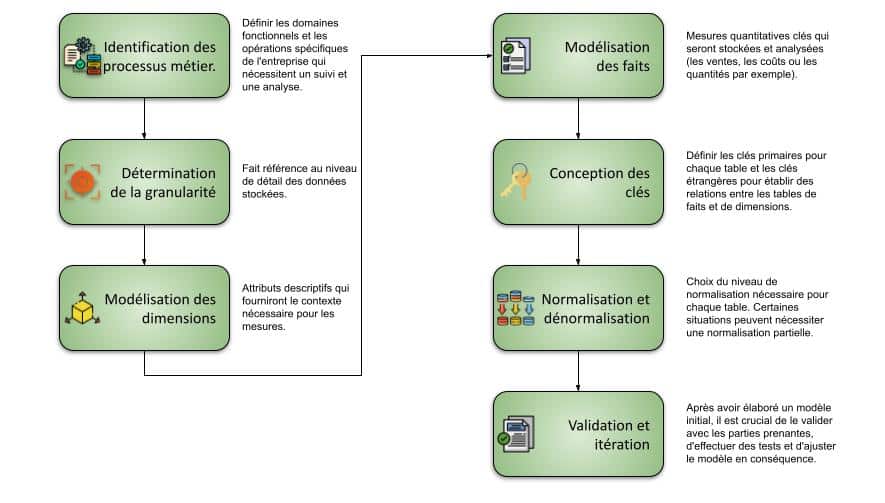
The successful implementation of a data warehouse relies heavily on rigorous, methodical design. Kimball’s method offers a structured process to guide designers through the essential stages of this complex task.
Kimball contre Inmon
Two iconic figures dominate the world of data warehousing: Ralph Kimball and William Inmon. These two experts have each proposed distinct approaches to data warehouse modeling and design.
| Principle | Kimball | Inmon | |

|
Philosophical foundations | Business-process oriented approach. The data warehouse is built incrementally, starting with the areas that deliver the most business value. | Centralized and holistic vision of the enterprise data warehouse, built first before creating derived data marts for specific needs. |

|
Architecture | Bottom-up approach, starting with data marts addressing specific needs, which are later integrated into a broader data warehouse. | Top-down approach, building a large enterprise data warehouse first and then deriving data marts for downstream use cases. |

|
Modeling | Dimensional modeling with fact and dimension tables, optimized for analytics and reporting. | Third Normal Form (3NF) modeling for the central data warehouse, ensuring maximum data integrity and consistency. |

|
Data loading process | ETL processes typically load data directly into data marts or the warehouse in a relatively simple flow. | Data is first loaded into the central warehouse, then transformed and distributed to data marts using ELT processes. |
|
|
Flexibility and consistency | Faster implementation and higher flexibility, though maintaining consistency across multiple data marts may require extra effort. | Strong enterprise-wide data consistency thanks to a unified model, at the cost of longer and more expensive initial implementation. |
Kimball and Inmon offer two different perspectives on the design and implementation of data warehouses. The choice between these approaches will depend on specific needs, available resources, and the company’s strategic objectives. Understanding the nuances of each method is essential to making an informed decision about which approach is best suited to a given situation.
Conclusion
The Kimball method, with its solid principles of dimensional modeling, offers a valuable framework for organizations seeking to optimize the efficiency, performance and flexibility of their information systems. However, like any methodology, it is not a one-size-fits-all solution. Companies need to carefully assess their specific needs, resources and long-term objectives to choose the approach best suited to their context.