Data Management Course
- Part-time: 3 months
Master every stage of data management: from data modeling and integration to quality, governance and security, using industry-standard tools like SQL, Talend, Power BI and Azure.
Key information

What you’ll learn,
in a nutshell
Learning goals
and methodology
Tuition and funding
Upcoming starting dates
Curriculum
What sets this training appart
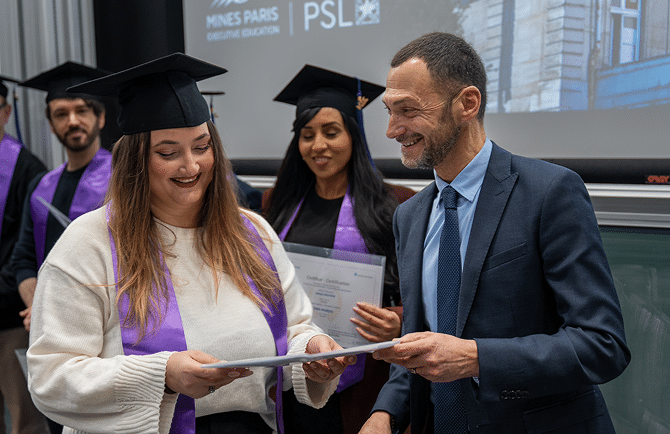
Academic recognition
This program trains you in the fundamentals of modern data infrastructure and business intelligence. You’ll also prepare for an official Microsoft certification exam. Last but not least, to validate your skills, you’ll complete a final capstone project, guided and assessed by our mentors.

Career support
Learners and graduates receive dedicated career support and gain exclusive access to professional events, opening doors to the right people at the right moment.

Alumni network
Join a network of 50,000+ alumni working across industries and top companies and in many different countries.
Key figures
Satisfaction rate
Learners praise the quality of the content, the personalized support, and the availability of instructors throughout the course.
Job placement rate
Among 2023 graduates, more than eight out of ten found a job within six months after completing the training.
Completion rate
The vast majority of enrolled learners successfully complete their training thanks to continuous support and an active teaching method.
Application process

1
Book an appointment
Choose a time slot to be contacted by one of our learning advisors.

2
Talk with an advisor
Discuss your training goals with one of our advisors. They’ll help you identify the program that best fits your profile.
3
Placement test
After your consultation, take the placement test to confirm your entry level.

4
Final steps and registration
You’re just a few steps away from starting your training and launching your new career!
Testimonials
-
Great Training Bootcamp! Thanks to the way Datascientest teaches and the constant support provided by the teachers, I was able to get the practical da…


-
I learned a lot in the program it is really an amazing platform to grow with your career and start with potential. I really felt helped and received a…

-
I am really amazed by the human quality of the Hack A Boss team, Selene, Dmitry, Pablo and Daniel are amazing people who are willing to help and teach…
-
I recently finished my Bootcamp for Data Analyst and I am very happy with the knowledge I gained and experience it gave me. The modules were very clea…
-
I find this platform is the best because it's an intelligent way of learning in this era, just text content plus some needed short tutorial videos. al…

-
I am really amazed by the human quality of the Hack A Boss team, Selene, Dmitry, Pablo and Daniel are amazing people who are willing to help and teach…
-
Just finished training yesterday (3 + 2 days). Group interactivity was effective, the instructor was very responsive. His experience in business as co…
-
I would like to share with you a great experience lived recently by following "Data Analyst Training". I have learnt lots of skills (Python, Data Anal…
-
Very high-quality training. Thank you for the presentation. I strongly recommend this training provider. It covers nearly all the key aspects needed t…
-
I completed a Data Engineer training program at DataScientest, and overall, the course is well-structured, a balanced mix of projects, theory, and han…
-
Now certified and very satisfied with the Data Scientist training, I’ve decided to continue my journey with DataScientest by enrolling in the MLOps …
-
An excellent training provider for Data-related careers. The courses are well-designed, and you’re quickly challenged through exams after each modul…
-
The training offers a solid overview of various Machine Learning techniques, and access to a wealth of content including coaching sessions, alumni tes…
-
The bootcamp program is really intensive, specially for a person who has no programming background, but the course is definitely worth it. It helped m…
-
As part of my career transition, I pursued my DevOps training through a work-study program at DataScientest. I chose to follow both courses with DataS…
-
Awesome education, awesome people.

-
I'm delighted to share my experience with this bootcamp! After completing my bachelor's degree, I was searching for a way to work with computers and d…
-
A lot of things to learn and a lot of information! was an amazing experience.
-
I’d like to share my feedback following the high-quality training I completed on Microsoft Power BI, delivered by DataScientest. This experience was…
-
Excellent course with practical focus! Really enhanced my data science skills, directly applicable to my research. Highly recommend DataScientest for …
-
Overall impression is good. The course content is well-organized, thoroughly designed and challenging as well. In the end, I believe I am well-prepare…
-
I really enjoyed the course material and the fact that everything was remote. Well I haven’t finished the MLOps part yet. The data science part was …
-
Onboarding was smooth & lessons on your own & remote were particularly adequate to me
-
Loved the format which was perfect for me as a young parent. Additionally, I found the resources (platform) to be very good, and the instructors to be…
-
I successfully completed my Data Analyst training last month and was very satisfied within just six months, I was able to learn the key fundamentals f…
-
I completed the Data Analyst course at DataScientest and found it to be a truly enriching experience. The content is up-to-date and highly practical, …
-
DataScientist.com is always interested in maintaining a good reputation and producing good graduates. But don’t be afraid, the instructors are very …
-
I’m really glad I chose DataScientest. Balancing work, family, languages and now data learning is challenging, and their flexible format makes it ea…
-
Probably the best Data & AI training course out there. Loved the structure, depth and hands-on approach of the Data Science & MLOps course. I …
-
The content of the module undoubtedly covers the most important aspects of Machine Learning and MLOps. The final project allows you to put into practi…
-
As a seasoned software engineer with many years of experience, I was looking to refresh my IT skills and deepen my knowledge in data-related technolog…









Our courses
Not the right fit ?
Take a look at our other programs
Data & AI
Turn data into actionable insights. Learn to use essential Data Science and AI tools to create predictive models.
Cloud & Dev
Build fast, powerful web apps. Work with scalable databases and cloud tools used by today’s top tech teams.
Got questions?
Find the answers here
Companies have now become aware of the quantities but above all of the potential that data represents . Its management is therefore all the more important to guarantee that it is scientifically sound and used, fully documented and transparent or even easily accessible and usable.
This high level of well-defined requirements has increased the need for professionalism in data management activities, which promotes rigorous auditing and reporting of compliance. As a result, many professions have emerged: data analyst, data scientist, data engineer, etc. However, these professions could not exist without a key element: data. However, it is not free from errors, evils or manipulations, someone must take care of its management, it is the Data Manager.
The Data Manager manages data assets to improve their reusability, accessibility and quality . It approves data naming standards, develops consistent data definitions, and documents business rules. This then results in a unification of the company’s data.
The Data Management referent is responsible for ensuring the integration of the following data:
– Naming standards
– Definitions of Entities and Attributions
– Specification of business rules
– Specification of calculation methods
– Data quality and data retention criteria
– Source the data
– Data Security Specification
Such an integrated view forms the basis of the shared data that is essential in data warehouses. The data manager must understand the technical issues of data integration .
It is usually exposed to the business world while modeling business rules, entities and attributes of data.
Data Manager roles and responsibilities may vary depending on the maturity of the data program within the company.
Those in positions new to the company focus more on tasks to consolidate data from platforms and establish processes to best manage the data.
Those in companies with the most mature data programs typically focus on higher value-added tasks ( data quality assurance, standards compliance, etc. )
In general, the missions of the referent in Data Management are the following:
– Guarantee the quality of the data collected and used by the company
– Troubleshoot data integration issues
– Ensure data security and manage regulatory risks
– Document the data , calculations, summaries, etc.
– Update the rules governing access to data (confidentiality)
In summary, data management leaders are responsible for the management and quality of all data within the company and ensure that the data rules established by the data governance program are followed. By acting as intermediaries between information systems and users, they are probably the most sought-after profiles today.
The daily tasks of the data manager revolve around the following:
– Define Data Governance processes and their implementation
– Establish data contracts and policies and ensure that these are respected within the company
– Update data mapping (collection, storage, processing, destination) – Ensure legal compliance and -security of data handling
– Control the quality and detect irregularities (cleaning of data, quality controls, coordination of improvement actions, etc.)
– Develop monitoring indicators and create reports, KPIs to ensure optimal functioning of data processes
– Improve data accessibility
– Establish a diagnosis on the data heritage (value, quality)
– Educate the different teams on how to use the data so that they can take ownership of it and monitor its use.
Designate a manager within the Data Stewards team who will be responsible for overseeing each of the main data areas.
Divided into a team, the Data Stewards will be responsible for resolving data integration issues in their own domain. The results will then be transmitted to data administrators and databases and then integrated into the company’s data models.
Just as there is a Data Architect in most data administration functions, there should also be a manager with a Data Management background who determines and controls everyone’s domain.
– A precise vision of Big Data, its challenges , its environment and its main technologies and solutions
– An understanding of the importance of data management in business strategy
– Control of the temporal operation of the data and a guarantee of its quality
– Expertise in aligning the various businesses with the data life cycle
– An ability to transform large volumes of different data into useful and actionable information
– An ability to identify specific business needs and restore data to them
On the first day of your entry into training, a platform dedicated to career services containing all the workshops essential to your job search will be presented to you. You can access it continuously, even after the end of your training.
Mathilde and Morgane, our career managers are entirely dedicated to you throughout your training. It is possible to make an appointment individually with one of them in order to accompany you and answer any questions you may have about your career plan.
In addition to this, career workshops are organized every month:
– A workshop to help you write a good CV and data-oriented Linkedin
– A workshop to help you strategize your job search with different topics on presentation, career change, salary negotiation and technical test training. In addition to these subjects, there are other workshops to be defined according to individual needs.
On the other hand, concrete actions are put in place to support you in your job search: recruitment fair organized by Liora with its partner companies, organization of Webinars with data experts, communication actions to boost your visibility (CV competition, DataDays, project articles published on the blog and external reference media).
To find out about all of Liora’s career support actions, click on this link.
To follow a data management training, it is necessary to have at least a BAC or qualified professional experience
Knowledge of a programming language or professional experience in data is appreciated.
This job involves a fairly substantial share of information transmission, notions of communication and marketing will also be an advantage for the person wishing to train. Even if the training is centered on the organization and management of data, mathematics remains an essential component for a good understanding of the logical principles that will be discussed. People with prior knowledge of certain statistical principles (expectation, variance, algebra, etc.) will progress more quickly in the training and will be able to approach new concepts in our training more easily.
These training courses are also accessible to anyone with a scientific profession, professional qualifications being generally sufficient to develop those essential to Data Management professions.
Once you have registered on the website, we contact you to present Liora and its offers as well as to discuss your background and your wishes so that they coincide with our training courses.
Then, a technical test of positioning essentially mathematics of probability/statistics and fairly basic algebra is submitted to you. This does not sanction you in any way and is only used to position you. A member of the admissions team will then contact you to inform you of the results and discuss your motivations and the relevance of your project.
So far, you are not engaged with Liora and can, according to your convenience, not continue your steps.
The registration phase will only begin after your project has been confirmed. From then on, our teams will take care of organizing your Data Management training.
To combine flexibility and motivation, Liora’s pedagogy is based on hybrid professional training . This makes it possible to combine flexibility and rigor without compromising on one or the other. A 100% distance training combining synchronous (masterclass) and asynchronous times (courses and exercises on the ready-to-code platform) so that motivation is always there. This translates into 85% learning on the coached platform and 15% masterclass session by videoconference.
The courses are given by videoconference but the follow-up remains the same with teachers available and attentive to your progress throughout your training.
Of course ! And who better placed to provide support than our trainers, who also designed the program . They are available and attentive to all questions, both theoretical and practical, to which they will not hesitate to answer by demonstrating pedagogy.
In addition, your progress will be closely monitored by our teachers, concerned about your success and your commitment. Any disconnection for an extended period will be notified to your cohort manager who will immediately hear from you: we won’t let you down !
Finally, the hand correction of papers, exams and defenses will be carried out by our panel of qualified teachers: the learning format has been designed so that everyone can progress at their convenience and efficiently. We are deeply convinced that quality learning can only take place through personalized follow.
Beta-tests are made available for our alumni to stay up to date and develop new data skills even after the end of the training.
At the same time, newsletters drawn up by our Data Scientists are regularly sent and are a reliable source of specialized data science information.
Finally, the Liora community continues to grow, and with it all of its alumni. To keep in touch and allow former students to communicate with each other, Liora has set up a group of alumni on LinkedIn who share and discuss various themes around Data Science.
The DatAlumni community is a LinkedIn community that brings together Liora alumni . On this page, questions, tips and technology news are shared for everyone’s benefit. In addition to this, Liora will launch in the coming weeks a trombinoscope which will put alumni in contact, this one will include the company and the position of each one.
Initially, Liora supported the data transition of companies. This has made it possible to create strong links with the major groups which have ensured the growth of our structure.
Subsequently, they are the ones who motivated the launch of our offer to individuals in order to compensate for the lack of competent profiles. This need for good profiles is reflected in the survey we conducted among 30 CAC 40 groups . Even if they had tight budget constraints, only 4% believe they would downsize their data scientist workforce; by comparison, 28% would still seek to increase their number by more than 20%.
With our experience with large companies, we regularly organize recruitment fairs with our partner companies, addressed to all our students and alumni.