Blended learning combines online courses with face-to-face or coached courses. It is becoming increasingly popular with learners who want to receive quality training at their own pace and according to their schedule. But what does it mean and what are the advantages and disadvantages of this training method?
The lack of professional recognition, redundancy, and the desire to live from their passion lead more and more people to initiate a professional reconversion and to take a training course. While some of these courses may seem long, costly, and tedious, more and more training organizations are offering learners the opportunity to take a course in the form of blended learning.
A training in 2 learning methodologies
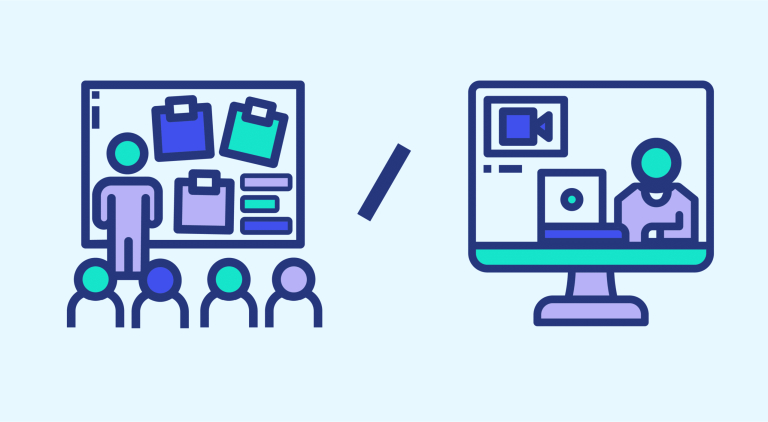
Blended learning uses several learning methodologies. This new training method combines group or individual face-to-face classes with distance learning, whether on the Internet, via videoconferencing or by phone.
- The face-to-face part allows the learner to benefit from the support of a trainer or a coach. This will allow an exchange between the two parties and offer the learner the possibility to ask all his questions directly. The human presence of a trainer reassures many learners who can sometimes get lost in the online world.
- The autonomous part allows the learner to manage his personal or professional schedule and his training time. They follow the courses at their own pace, at a distance, and become masters of their learning.
This new learning method is becoming more and more popular with both individuals and companies. What are the advantages of this training?
The advantages of blended learning
Increasingly popular with companies, blended learning offers them many advantages:
- Drastic reduction in training costs: companies are no longer obliged to finance travel costs, catering costs, room rental costs if necessary, trainer costs, etc. for the entire duration of the training.
- Reduced employee downtime: by combining face-to-face and distance learning, the company reduces the amount of time its employees are away from their workstations.
- Saving time and better optimization of training and pedagogy.
Blended learning also offers certain advantages to those who benefit from it:
- Possibility to organize themselves according to their constraints and schedule.
- The learner is involved in his training because of his great autonomy and his responsibility for the remote part.
- The face-to-face part reassures the learner who feels followed, and the online part offers great flexibility, allowing him to learn at his own pace, which can be a source of additional motivation.
What are the drawbacks?
For some learners, the fact of following part of the training in total autonomy, via digital tools can be a brake. The learner must be responsible and organized to be able to integrate this training time into his schedule. The lack of a trainer during the training session can also represent a difficulty in case of questioning or misunderstanding.
However, you should know that in general the digital part offers online help via chat, email, or phone, but the answers are not necessarily delivered in real-time. People who are not comfortable with digital tools may also experience difficulties during the distance learning course. To overcome these drawbacks, Liora provides its learners with a team of data scientists, who can be reached by chat, and distills introductory sessions to the platform, specially dedicated to helping everyone get the hang of it.
Why choose a blended learning course?
Blended learning is a good compromise between face-to-face and distance learning. However, this type of training must meet specific objectives for both the company and the learner. This type of training may not be suitable for all sectors of activity and all positions in the company. Management, marketing, and data functions, for example, lend themselves well to it. This is why Liora has chosen this format for its data science training courses, and adapted the formula so that it corresponds to all needs.